How People Become Unstoppable

There is a version of “unstoppable” that gets sold online that I don’t trust.

Become unstoppable during the unseen hours

It is usually loud.
It is usually polished.
It usually looks like somebody who never doubts, never breaks, never gets tired, never questions the path, and never has to drag themselves through a hard day.

That is not unstoppable. That is performance.

Real unstoppable people are not made of steel. They still get hurt. They still lose confidence. They still have moments when the plan falls apart and the future gets quiet.

The difference is not that life never knocks them down. The difference is that they learn how to return.

That is the part most people miss.

Unstoppable is not a personality type. It is not a motivational mood. It is not something you either have or do not have. It is trained. And often, it is trained in the exact moments when you would rather disappear.

Unstoppable People Do Not Wait to Feel Ready

Most people give their emotions too much authority.

They wait to feel motivated before they move. They wait to feel confident before they take the shot. They wait to feel clear before they decide. They wait to feel inspired before they create.

The problem is that feelings are weather. Some days they help. Some days they do not.

If your entire future depends on waking up in the right emotional climate, you are going to be inconsistent.

Unstoppable people still have emotions. They just do not let emotion have the final vote. They build standards.

A standard is different from a goal. A goal says, “I want to write the book.”
A standard says, “I write today.”

A goal says, “I want to be a better athlete.”
A standard says, “I train when nobody is impressed.”

A goal says, “I want to lead.”
A standard says, “I tell the truth even when it would be easier to be liked.”

That is where things start to change.

You do not become unstoppable because every day feels powerful. You become unstoppable because your behavior is no longer controlled by whether the day feels powerful. There is a kind of freedom in that. You stop asking your mood for permission. You have an identity built in that is unstoppable!

Pressure Becomes Information

Pressure has a way of revealing what we would rather not see. That is why we resist it.

Pressure exposes weak habits.
It exposes vague commitments. It exposes whether our confidence was built on preparation or applause. It shows us where we have been coasting, where we have been pretending, and where the system is not strong enough yet.

That can be uncomfortable. . . Good.
Comfort does not reveal much.

The missed free throw tells you something.
The rejected application tells you something.
The awkward sales call tells you something.
The failed launch tells you something.
The hard conversation tells you something.

Average performers take pressure personally. They see it as a verdict.
Unstoppable people learn to treat pressure as data… as information.

That does not make pressure painless. I am not interested in pretending that every hard moment is secretly wonderful. Some hard things are just hard. Some losses hurt. Some seasons take more out of you than you expected. But even then, the question matters.

A weaker question is, “Why is this happening to me?”
A stronger question is, “What is this requiring from me?”
That question changes your posture.

Now pressure is not just something to survive. It becomes something to study. It shows you the next skill. The next adjustment. The next truth. The next system that needs to be built.

Pressure becomes a coach. Not always a gentle one.
But often an honest one.

They Stop Worshiping Talent

Talent is real, but talent is not enough.
I have seen gifted players get passed by less gifted players because the less gifted player was more coachable. More consistent. More willing to be corrected. More willing to do the boring work.

That happens in sports, but it happens everywhere. The talented writer who never finishes loses to the consistent writer who publishes. The talented speaker who never pitches loses to the average speaker who keeps getting reps. The talented coach who cannot adapt loses to the coach who keeps learning. The talented entrepreneur who keeps chasing new ideas loses to the one who builds a simple offer and improves it.

Talent gets attention. Training creates separation.

One of the most dangerous things talent can do is make you allergic to being a beginner. If you are used to being good, awkwardness feels like failure. Correction feels like disrespect. Slow progress feels like proof that maybe you are not who you thought you were.

That is a trap.

Unstoppable people are willing to look unimpressive while they are improving. That is rare.

Most people want the rewards of mastery without the humility of practice. They want the identity before the reps. They want the respect before the evidence.

But growth has an entry fee.
The entry fee is humility.

You have to be willing to be coached. You have to be willing to miss. You have to be willing to adjust without turning every correction into a crisis.

The people who keep leveling up are not always the most naturally gifted. They are the ones who can keep learning after their ego gets bruised.

Confidence Comes From Promises Kept

Confidence is not hype.

You can talk yourself up all day, but some part of you is always keeping score.

You said you were going to start. Did you?
You said you were going to follow up. Did you?
You said you were going to finish. Did you?
You said you were going to change the pattern. Did you?

This is not about perfection. Nobody keeps every promise flawlessly. But when you casually break your word to yourself over and over, you damage self-trust. And when self-trust is low, every hard thing feels heavier.

Unstoppable people protect self-trust. They do not do it by making massive promises. They often do it by making smaller promises and keeping them.

One page.
One workout.
One phone call.
One honest conversation.
One follow-up.
One deliberate action.

Small promises count.

In fact, small promises may matter more because they train the nervous system to believe, “When I say something matters, I act like it matters.” That is the foundation of earned confidence.

Not fake confidence. Not loud confidence. Not social media confidence.
The quiet kind.
The kind that says, “I have been here before. I know how to move.”

They Survive the Boring Middle

Most people can start. Starting has energy. Starting has imagination. Starting lets you picture the better version of your life. The new plan feels clean. The new notebook feels promising. The first workout feels symbolic. The first chapter feels alive.

Then comes the middle. The middle is quieter.

The middle is where progress slows down. The middle is where nobody is clapping yet. The middle is where the work starts looking ordinary. The middle is where doubt gets sneaky because nothing is technically wrong, but nothing is happening fast enough either.

This is where many people quit. Not because the dream stopped mattering. Because the work stopped entertaining them. That is one of the most important truths about becoming unstoppable.

You have to learn how to keep going when the process becomes boring.

The athlete still has to get shots up.
The writer still has to edit.
The entrepreneur still has to follow up.
The coach still has to teach the same fundamentals.
The person rebuilding a life still has to make the next clean decision.

The middle does not feel legendary while you are in it. But the middle is where identity gets built.

The world sees the breakthrough. It rarely sees the repetition that made the breakthrough possible.

Unstoppable Does Not Mean Unbreakable

This is where we need to be careful.
Unstoppable does not mean invincible.

Invincible means nothing gets through.
Unstoppable means something may get through, but it does not get the final word. That distinction matters.

Because if you think unstoppable means unbreakable, you will feel like a failure the first time life hits hard enough to hurt you.

But pain does not disqualify you. Doubt does not disqualify you. Fatigue does not disqualify you. A hard season does not disqualify you.

The question is not whether you ever struggle. The question is what you do after the struggle tells you the truth.

That is where the “Nothing’s Working” moment becomes so important.

Everybody gets there eventually.

The plan fails.
The job changes.
The relationship breaks.
The team struggles.
The body does not respond the way it used to.
The opportunity disappears.
The thing you counted on does not come through.

In that moment, the goal is not to pretend everything is fine. The goal is to stabilize. Tell the truth. Adjust the story. Make the next decision you can actually make. Then take one deliberate action.

Not the whole staircase. Not the whole comeback. Not the whole future.
One deliberate action.

That is how people return.

The Real Formula

If you want the practical version, here it is…
Unstoppable people train standards so they do not need perfect motivation.

They train their response to pressure so hard moments become information instead of identity.

They train humility so talent does not become a ceiling.

They train self-trust by keeping promises.

They train patience so boredom does not beat them before adversity does.

None of that is flashy. But it works.

And maybe that is why so many people miss it. They are looking for the dramatic secret when the real secret is usually quieter.

Show up when the mood is not there.
Tell the truth when excuses are available.
Make the adjustment when pride wants to argue.
Keep the promise when nobody would know if you broke it.
Return when quitting would be understandable.

That is the pattern. Not perfection.

Return.

Not hype.

Return.

Not pretending you never got hit.

Return.

And if you do that long enough, people may eventually call you unstoppable. But by then, you will know the truth. You did not become unstoppable because life stopped challenging you.

You became unstoppable because you stopped abandoning yourself every time it did.

Your Next Step

If you are in a season where nothing seems to be working, do not try to fix your entire life at once. Start by getting stable. Start by telling the truth. Start by identifying what is still within your control.

That is why I created the Hard Season Survival Guide. It is a practical reset tool for the moments when pressure is high, clarity is low, and you need a way to move without pretending everything is fine. It is a shorter version of my book “Nothing’s Working: What to do when life falls apart” and the Hard Season Survival Guide can be downloaded for free here. (Or buy a hard copy from Amazon click here).

And if you are an athlete, coach, or leader who wants to build this into a repeatable performance system, the Winning Mindset Playbook will help you train the standards, habits, and responses that make people harder to derail.

Unstoppable is not magic.

It is trained.

Let’s Roll.

Motivation Is Overrated. Discipline Is Suspicious. Talent Is a Trap.

Motivation? Discipline? Talent? Identity is the engine

Everybody wants more motivation.

Athletes want to “feel locked in.”
Entrepreneurs want to “get inspired.”
Students want to “find the drive.”
Adults want to “finally get disciplined.”

But here’s the uncomfortable truth:
If you need motivation to do it, it probably has not become part of who you are yet.
That may sting a little. Good.
Because most people are not losing because they lack motivation.
They are losing because they are trying to act like someone they have not yet decided to become.

Motivation Is a Visitor

Motivation comes and goes. It shows up after a great speech, a big win, a new year, a fresh notebook, a clean workout plan, or a scary doctor’s appointment.

Then life hits . . .

  • You get tired.
  • You get bored.
  • You get criticized.
  • You get busy.
  • You get disappointed.
  • You get human.

And suddenly the “motivated” version of you disappears.

So here’s the question:
Was that motivation… or was it just emotional weather?

You cannot build a life on weather.
Motivation is useful. But it is not the foundation. It can be the spark, but it won’t become the structure.

Discipline Is Not the Goal Either

People love to say, “You just need more discipline.”
Maybe.
But maybe discipline is not the real issue. Maybe discipline is what we call it when identity has not caught up yet.

Think about it.

A person who says, “I’m trying to quit smoking,” is fighting a different battle than the person who says, “I’m not a smoker.”

A player who says, “I’m trying to get shots up,” is in a different world than the player who says, “I’m a shooter. This is what shooters do.”

A student who says, “I need to study,” is different from one who says, “I’m the kind of person who prepares.”

Same actions. Different identities.

And identity changes the weight of the action.
When something violates your identity, it feels heavy.
When something confirms your identity, it feels natural.

That is why the goal is not to become more disciplined forever. The goal is to become the kind of person who needs less internal debate.

Talent May Be the Most Dangerous Word

Talent is real.
But talent is also one of the easiest places to hide.

“I’m just not talented.”
“I’m naturally gifted.”
“She has it.”
“He doesn’t.”

Those phrases sound like analysis.
Most of the time, they are excuses wearing a nice jacket.

Talent can get you noticed . . .
Identity determines what you do after people stop noticing.

Talent might open the door . . .
Identity decides whether you keep showing up when the room gets quiet, when the work gets boring, when the results are delayed, when nobody claps, when the scoreboard is not kind.

Here’s the counterintuitive fact:
Practice matters, but research on deliberate practice has found that even in sports it explains only part of performance differences.

That should humble everyone. It means talent is not everything.
But practice is not magic either.

So what fills the gap?
Identity.

Who do you believe you are when the work gets hard?

Identity Is the Hidden Operating System

Your identity is not what you say in public. It is what you obey in private.

motivation discipline talent . . . identity. Think about it.

It is the story underneath your habits. It is the sentence your nervous system believes before your mouth gets involved.

“I am not good under pressure.”
“I always quit.”
“I am bad with money.”
“I am not a leader.”
“I am not athletic.”
“I am not smart.”
“I never follow through.”

Those are not harmless thoughts.
They are instructions.

And your life will usually drift toward the identity you keep rehearsing.

So the real question is not, “How do I get motivated?”

The better question is: What identity would make this action obvious?

Not easy. Obvious.

IDIA: I Do It Anyway

This is where IDIA matters.

I Do It Anyway.

Not because I feel like it.
Not because I am in the mood.
Not because the conditions are perfect.
Not because I am fearless.
Not because I am already great.

I do it anyway because every action is a vote for your identity.

Every rep votes.
Every page votes.
Every walk votes.
Every apology votes.
Every hard conversation votes.

Every practice, every cold call, every honest meal, every finished workout, every completed assignment, every “next right step” casts a vote for the person you are becoming.

You do not build identity by thinking harder. You build identity by proving something to yourself.

You start with Small proof.
Repeated proof.
Honest proof.

The Real Order Is Backwards

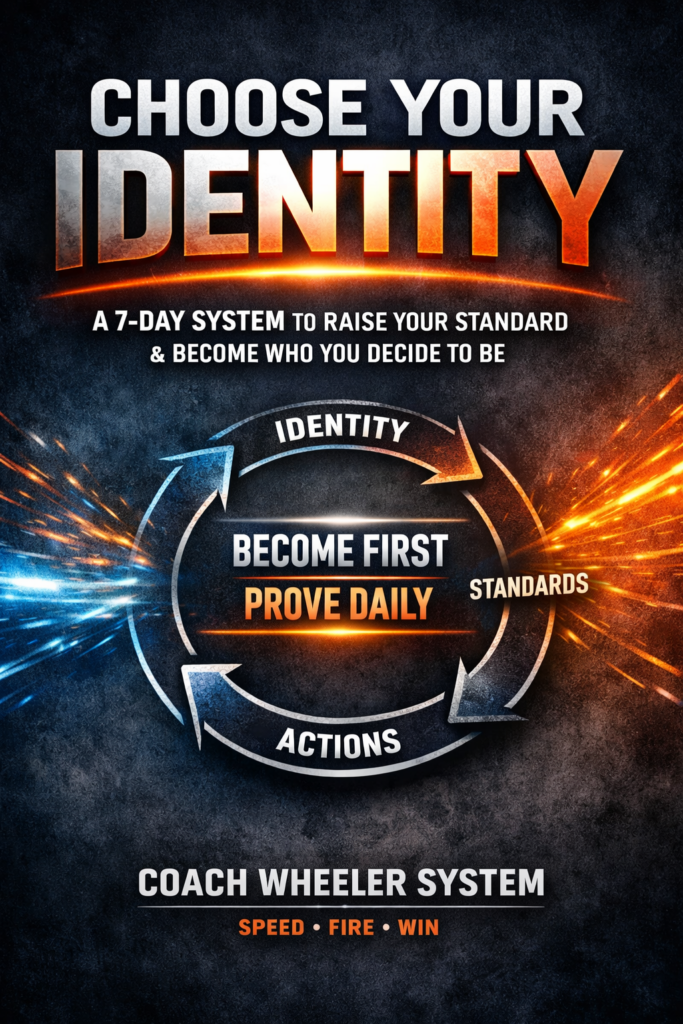
Most people think the sequence is: Motivation → Discipline → Action → Identity

But the better sequence may be: Identity → Decision → Immediate Action

That is IDIA in motion.

I am this kind of person.
So I make this kind of decision.
Then I do it anyway.

Motivation may show up later.
Confidence may show up later.
Talent may show up later.

But action comes now.

Stop Asking the Wrong Question

Stop asking, “How do I stay motivated? disciplined? leverage my talent & identity?

Ask: Who am I becoming?
What would that person do next?
What action would prove it?
Where am I still negotiating with an old identity?
What have I been calling a discipline problem that is really an identity problem?

Because the old version of you does not disappear because you read a quote or a great blog article by a famous coach.

It gets replaced when you stop feeding it bad evidence.

The Mindset Shift

You do not need to feel like a winner to act like one.
You do not need to feel confident to prepare.
You do not need to feel disciplined to take the next step.
You do not need to feel talented to train.
You do not need to feel ready to begin.
You need one honest action that says: “That old story is not in charge anymore.”

That is how identity changes.

Not in a lightning strike.
Not in a motivational high.
Not in one magical transformation.

Identity changes when you repeatedly catch yourself at the edge of the old pattern and choose differently.

That is the work.
That is the win.
That is IDIA.

I Do It Anyway.

Let’s Roll.

**** If you liked this article about how motivation discipline talent are nothing compared to identity . . . ****

Check out Coach Wheeler’s free ebook titled “The Winning Mindset Playbook“. Download here.

motivation discipline talent . . . identity

The Way of Winning: Identity First (Why You Don’t Rise to Your Goals)

Most people try to change their life by changing their actions.

Things like …

  • Workout plans.
  • Content schedules.
  • New goals.
  • New systems.

And it works… for a few days.

Then something breaks.

Not because the plan was wrong.

Because the identity never changed.


Xplain: Life Follows Identity

Here’s the truth most people miss:

You don’t rise to your goals.

You fall back to your identity.

If you see yourself as inconsistent… you’ll find a way to stop.
If you see yourself as “getting older”… you’ll slow down.
If you see yourself as “still figuring it out”… you’ll hesitate.

But if you see yourself as disciplined, focused, and dangerous in your pursuit?

Everything starts to organize around that.


The Olympic Thought Experiment

Let’s go back to the scenario.

You wake up tomorrow:

  • Out of shape
  • Slower
  • Softer
  • Off track

But in your mind…

You are still an elite-level athlete.

What happens?

You don’t panic.
You don’t scroll for a new program.
You don’t wait for motivation.

You train.

You clean up your nutrition.
You structure your day.
You eliminate distractions.

Not because you’re “trying to get back.”

Because that’s who you are.

That’s the difference.


Xample: The Silent Battle You’re Losing

Most people are fighting the wrong battle.

They’re trying to force behavior that doesn’t match their identity.

  • “I should work out” (but I don’t really see myself as an athlete)
  • “I should write more” (but I don’t really see myself as a writer)
  • “I should be more disciplined” (but I’ve always been inconsistent)

So every action feels heavy.

Every decision becomes a negotiation.

And negotiations drain energy.

Winners don’t negotiate with themselves all day.

They act in alignment with who they’ve decided to be.


The Edit That Changes Everything

There’s a concept I love:

Edit your life.

Not your intentions.
Not your goals.

Your life.

That means every day, every action runs through one filter:

Does this move me closer to who I am?

Not who you want to be.

Who you’ve already decided you are.

And once that’s clear, things get simple.

  • Junk input becomes obvious
  • Time-wasting disappears
  • Weak choices feel off
  • Strong choices feel automatic

You don’t need more discipline.

You need clarity and alignment.


Xchange: The Identity Build System

Let’s make this real.

Here’s how you change identity in a way that actually sticks.


1. Decide Who You Are (Not Who You Hope to Be)

No soft language.

No “I’m trying to…”

You decide.

  • I am an endurance athlete training for an Ironman
  • I am a coach building a winning culture
  • I am a creator who publishes consistently
  • I am a disciplined operator

It should feel slightly uncomfortable.

That’s how you know it matters.


2. Set the Standard

Goals are optional.

Standards are not.

What does this person always do?

  • Trains on schedule
  • Fuels like a performer
  • Shows up early
  • Executes daily work
  • Tracks progress

Write these down.

These are your non-negotiables.


3. Remove What Doesn’t Fit

This is where most people fail.

They try to add new habits…

…without removing the old ones.

You can’t build a high-performance life on top of low-performance behaviors.

So cut:

  • Time leaks
  • Energy drains
  • Distractions
  • Weak environments
  • People or patterns that pull you off track

Editing is not optional.

It’s required.


4. Act Like That Person—Immediately

Not next week.
Not when you “feel ready.”

Now.

What would that version of you do today?

Do that.

Even if it’s small.

Especially if it’s small.

Because action creates evidence.

And evidence builds belief.


5. Stack Proof Daily

Identity is built through repetition.

Every action is a vote.

  • One workout = athlete
  • One post = creator
  • One disciplined decision = operator

You don’t need perfection.

You need consistency.

Stack enough proof… and doubt disappears.


The Real Advantage

Here’s where it gets interesting.

When your identity is strong…

You don’t fall apart when things go wrong.

You recover faster.

Because instead of saying:

“I blew it.”

You say:

“That’s not who I am.”

And you correct.

Immediately.


The Way of Winning

Winning doesn’t come from motivation.

It comes from identity.

You decide who you are.

You set the standard.

You remove what doesn’t belong.

You act in alignment.

You stack proof.

And over time…

There’s no gap left between who you are
and how you live.

Final Thought

You’re not as far away as you think.

The version of you that can do this…

already exists.

You don’t need to build them.

You need to step into them.

Then prove it.

Your Food Mindset

Cookie Monster - Your Diet Expert?
Are your food choices and eating habits similar to this guy?

Have you ever thought about how Food affects your Mindset? When you think about it, if you aren’t fueling your body with the right foods it is nearly impossible to perform at your best, either physically or mentally. Your food can also impact your mood… we have all been “Hangry” at one time or another (to quote a Snickers commercial). But is a candy bar really the right long term solution? This article will address what goes into developing and implementing a successful Food Mindset. In other words, we will cover what you need to do to improve your body & mind through the food you eat.

3W’s for developing a successful Food Mindset

(1) Why do you eat?  Are you eating for Health or for Fun? Are you usually eating to create your Best Body? Or is taste more important than nutrition for you? Does your food support a lean, low-fat body so that you are not carrying excess weight that will slow you down on the court? Or do you rely on food as a “drug” to manage your mood?

A clear idea of your motivation(s) when it comes to food will help you make better choices and stick to a plan that supports you reaching your potential on the court and in the classroom.

(2) What to eat. Do you have the knowledge you need so you know WHAT foods are the best to eat? Are you aware of what NOT to eat as well? There are many competing ideas when it comes to nutrition… from fad diets to traditional approaches to the latest research, so it can be nearly impossible to know everything.

I like to keep things simple. The first thing you need to know are the basic food groups… Fats, Proteins, Carbs. Within these groups there are good foods and bad foods. For example, there are “slow carbs” like veggies that boost your blood glucose level over a longer time versus “fast carbs” like pasta, sugary foods or soda which causes your blood glucose to spike to high levels quickly and then crash back down leaving you craving more food.

By converting food into blood glucose your body fuels your brain and muscles. This is how what you eat can have a huge impact on how you feel and how you will be able to perform.

As important as knowing WHAT to eat is knowing what NOT to eat (or at least limit as much as possible). There are three things (the 3 S’s) that are at the top of the list of foods to avoid… Sugar, Soda and Syrup.

Sugar is the ultimate “fast carb” and it shows up in more foods than you might imagine. It is not just candy. Sugar is included in things like bread, pasta and many other “fast carbs”. Quick note: veggies are ‘slow carbs’. Fruits are ‘fast carbs” but not quite in the category of sugars since fresh fruit often has fiber that helps your digestion system.

The second ‘S’ is Soda. Soda drinking is often just a habit, especially for young athletes. If you can change your “default drink” to water, your taste buds will adapt and eventually you won’t even want the sicky-sweet taste of sodas. Note: Diet Sodas are not the same as water, even if they claim ‘zero calories’. They are loaded with chemicals that are not doing your body any favors. Learn to drink water 1st !

The third ‘S’ is Syrup, in particular High Fructose Corn Syrup or HFCS. Don’t be tricked by the fact that it has “fructose” in the name and that is the sugar typically found in fruit. Plus it comes from corn, so how bad can it be? Plenty bad. It is even sweeter than sugar and is in almost every prepared food you find in the supermarket. Check food labels and work to remove it from your diet. Note: It won’t be easy… but with work it is possible.

Eating for Life by Bill Phillips

A good book on the subject of food for athletes is Bill Phillips’ “Eating for Life”(Amazon link). This book was a follow up to his successful book, “Body for Life“, (Amazon link ) which also has some great ideas to help you improve your Food Mindset .

(3)  When do you eat?  Your body is designed to handle time periods where you have plenty to eat as well as time when there is nothing to eat. In today’s society, we usually have plenty of food and, putting aside the quality of the food we choose to eat, the quantity of food nowadays is probably the largest contributor to the obesity epidemic.

Athletes are not exempt from obesity. As the saying goes, “You can’t out run a bad diet.” so no matter how hard you work out, you still need to dial in your diet. On top of that, few people today are choosing to ‘not eat’ and activate the “Fasting Protocol” portion of their metabolism.

The good news is that you don’t need to go without food for days and days to get the benefits of Fasting. Intermittent Fasting is when you limit WHEN you eat to a certain part of the day, usually 8 – 12 hours. This gives your body a chance to ‘fast’ for 12-16 hours every day and the result is that many of the ‘weak cells’ in your body don’t survive the fasting process. This leaves you with a higher percentage of healthy cells and since we are always making new cells we won’t miss the weak ones who get eliminated.

Side note: It has been shown that fasting for 3-5 days prior to chemo treatment makes the treatment more effective and reduces the side effects. Did you know that while cancer cells replicate faster than normal cells, they are also dependent on the availability of sugar (blood glucose) and are also weaker than healthy cells.

Implementing a successful Food Mindset

Once you know the 3W’s: Why you are eating, What you need to eat and When to eat, there are three key concepts that will turn your knowledge and motivation into a successful Food Mindset. They are Mental Discipline, Hydration and Personal Identity.

Mental Discipline

Mental Discipline is a skill that can be developed but it is much easier to build habits that allow you to conserve your mental willpower for other challenges you will face throughout the day.

One way to cultivate mental discipline / food habits  is to build a “cheat day” into your diet. Just knowing that you have one ‘cheat day’ per week can give you discipline to eat better for the other 6 days. You will probably find that even on your cheat day, you will eat better because “eating right” has become a habit as part of those other six days per week.

Coach Wheeler on How to create a compelling personal vision for your lifeAnother way to develop Mental Discipline is to use the power of both Plan & Process thinking. Coach Wheeler is developing a short (~10 minute) speech on creating a vision for your life. Part of that speech explains Plan vs. Process thinking. (Link to Coach Wheeler’s YouTube video – this is an early practice speech at Toastmasters).

In short, Plan thinking is having a goal and figuring out the steps you need to achieve that goal. Process thinking is geared toward “winning each moment”.  It is setting up processes that will lead “in the direction” of what you want. Process thinking is built on the idea that you might not be able to control the outcome of every step in your plan. But you can control how you approach everything you do on a day-by-day, moment-by-moment basis. When Plan & Process thinking are combined (with a clear Vision and Focused action… mentioned in Coach Wheeler’s video), your chances for success are greatly increased.

Translating this into your Food Mindset means that you have a Plan for the food you are going to eat. Plus you can execute that plan by implementing the Processes that produce success. Some process examples might include how you do the shopping, cooking and eliminating sources of bad choices. If you “win the shopping”, you are much more likely to have good food. Can you “win the cooking” and you set yourself up to eat better? By eliminating bad foods from your environment, you are making it easier to follow your plan.

Hydration

Hydration is one of the easiest things to overlook when it comes to your Food Mindset. As mentioned earlier, making water your default beverage is a good start. It offsets other (bad) alternatives such as soda but there is more to the story when it comes to water. Your body needs water. In fact, we are MOSTLY WATER and when our body is low on water, we often interpret it as “hunger”. It is always a good idea to drink some water when you first feel hungry. This way you aren’t taking in extra calories when you are really just thirsty.

Hydration is critically important for athletes. It is good to imagine that “sweat is weakness leaving your body”. You also have to replenish the water in your body to operate at your best. Keep in mind… we are losing water through evaporation even when we are not soaked in sweat. Every breath leaves with a bit of water. (That’s what you see in the winter when you can see your breath.) Every time you go to the bathroom, your body is using water to eliminate waste from your system. That’s why you need to be aware of your hydration level.

A good way to look at hydration is to monitor the color of your pee. If it is dark yellow, you are dehydrated. If it is almost colorless, you are probably in good shape. Note: This is a guideline and does not address illnesses that might affect the color of your urine. I don’t pay a doctor online … or in real life, so get medical attention if something seems out of line.

Identity

Coach Wheeler's book, Fat is all in your HeadFinally, the last part of your Food Mindset is your Identity. This is how you see yourself.

Are you an athlete (so you eat good foods that allow you to perform at your best)? Or are you a generally lazy person who eats whatever is offered or “tastes good”? Y0ur identity shapes all of your decisions in life, not just food. If you want to learn more about how you can shape your identity so it supports your Food Mindset, check out Coach Wheeler’s book, “Fat is all in your Head“.  It starts out with the story of how Coach Wheeler lost over 50 pounds by changing his thinking.

Bottom Line…

Your Food Mindset is up to you. It can impact all areas of your life. The sooner you take control of the food you put in your mouth, the sooner you will start to achieve your potential. On the other hand, you could continue to let it slide. And your goals will continue to slide away from you as well. The choice is yours. Please leave a comment below and tell us what you decide!