
Greatness On Demand (G.O.D.): The Mindset That Wins in Pressure Moments

And, guess what, the “Moment” Doesn’t Care If You’re Ready

There’s a moment in every game, every meeting, every life.

The score is tight. The clock is low. The pressure is real.

And nobody asks:

“Hey… are you feeling confident today?”

No.

The moment arrives anyway.

And in that instant, there are only two types of people:

  • Those who hope they’ll be ready
  • Those who have trained for Greatness On Demand

What Is G.O.D.?

G.O.D. = Greatness On Demand

Is your Greatness On Demand?
Do you have Greatness On Demand?

It’s not talent.
It’s not hype.
It’s not a lucky streak.

It’s the ability to access your best—on command—when it matters most.

Not someday.
Not when you feel like it.
Not when conditions are perfect.

Right now. Under pressure. With everything on the line.


The Lie Most People Believe

Most people believe in what I call “Someday Greatness.”

  • “I’ll be great when I’m ready.”
  • “I’ll perform when I feel confident.”
  • “I’ll step up when the time is right.”

That’s a fantasy.

Because the truth is:

The moment doesn’t wait for your confidence.

It demands your performance.

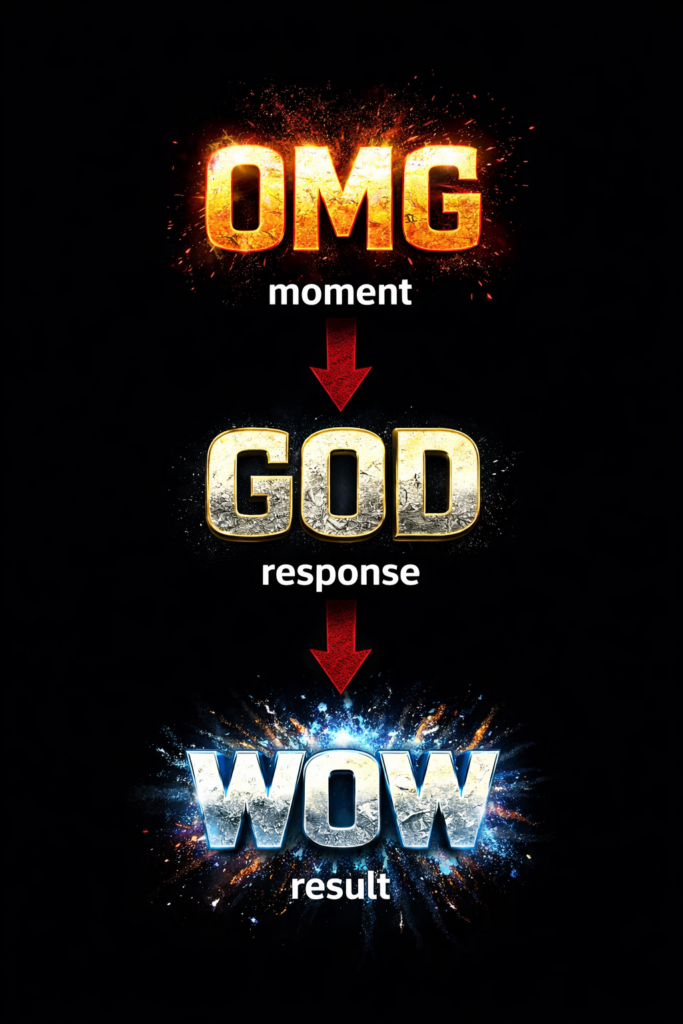
O.M.G. [Own My Greatness] moments

You’ve felt them.

OMG... Owning My Greatness!
OMG… Owning My Greatness!
  • Game-winning free throws
  • Final possession
  • Big presentation
  • Opportunity that shows up unexpectedly

That’s an OMG moment.

Everything speeds up.
Your heart jumps.
Your brain starts talking.

And most people… hesitate.


The Shift

Winners don’t panic at OMG moments.

They recognize them.

They’ve seen them before.

They’ve trained for them.

So instead of fear, they think:

“This is it.”

And then they activate:

G.O.D. – Greatness On Demand


The Sequence of a Winner

There’s a pattern here if you look closely:

OMG — The moment appears
GOD — You deliver
WOW — The world reacts

That’s the cycle of greatness.


How Do You Build G.O.D.?

Greatness On Demand isn’t magic.

It’s trained.

Here’s how.


1. You Stop Negotiating With Yourself

Most people hesitate.

Winners decide faster.

They don’t ask:

  • “Should I go hard today?”
  • “Do I feel like it?”

They move.

Action creates traction.


2. You Practice Under Pressure

Easy reps don’t prepare you.

You need:

  • time pressure
  • fatigue
  • consequences

Because when your body is tired…

your habits take over.


3. You Build Default Behaviors

When things get intense, you don’t rise to the level of your goals…

You fall to the level of your systems.

G.O.D. people build systems like:

  • sprint back on defense
  • shoot with confidence
  • speak clearly under pressure
  • act immediately

4. You Learn to Love the Moment

Most people fear pressure.

Winners recognize it.

They think:

“This is where I separate myself.”


A Simple Test

Ask yourself:

When the moment comes… do you want it?

Or do you avoid it?

Because G.O.D. isn’t just about ability.

It’s about ownership.


What G.O.D. Looks Like in Real Life

  • The player smiling at the free throw line
  • The entrepreneur hitting “publish” before it’s perfect
  • The coach making the bold call
  • The speaker stepping forward instead of shrinking back

No hesitation.

No delay.

Just:

Go.


Why This Concept Hits Different

Because deep down, everyone knows:

They’ve had moments…
…and didn’t step into them.

That feeling sticks.

G.O.D. is the opposite of that.

It’s the identity of someone who says:

“Next time… I’m ready.”


The Shirt Isn’t Just a Shirt

When you see it:

It’s not decoration.

It’s a reminder.

A signal.

A standard.

To yourself… and to everyone around you.

Imagine This

You walk into the gym.

Black shirt. Bold letters: G.O.D.

No explanation needed. Someone reads it. They get it instantly.

They know:

This person came to perform.

And When You Walk Away…
They see the back.

Now it’s not just a shirt.

It’s a system.

Final Thought

You don’t get to choose when the moment comes.

But you do get to choose how you prepare.

So the real question is:

When your next OMG moment hits…

will you hope you’re ready?

Or will you deliver

Greatness On Demand?
Mental Models & the OODA Loop

What am I talking about when I say “Mental Model”?

A Mental Model is a concept in your mind of HOW to solve a particular type of problem. For example, you might think that the way to put out a fire is to pour water on it.

You may think this because you tried it and it worked or someone told you that it would work. In many cases this mental model for putting out a fire works extremely well… but there are some cases when it is the last thing you want to do.

What if the fire is a grease fire? If you pour water on a grease fire, it will make it even worse. Check out the short video below to see what happens.  There are a number of alternative mental models for putting out fires that would work better such as cutting off the oxygen to the fire (by putting a lid on the pot if the grease fire is in a pot).

For other types of fires, a better approach (or mental model) might be to crush it or stamp out the fire. Or your mental model might tell you to find an appropriate fire extinguisher and use it on the fire.  Clearly there are many mental models and many ways to solve a problem.

Value of 3M – Multiple Mental Models

As we saw in the previous example, having multiple mental models can make us more adaptable to different types of problems that might arise. We all know someone (maybe ourselves) who is like the man who only has a hammer so everything in his world looks like a nail!

3M (Multiple Mental Models) is especially important in changing situations where our old models might not be the best choice. Add to this the Uncertainty that must arise when we realize that our observations, almost by definition, are imperfect.

We view everything through the lenses of our past experiences and values. If something doesn’t fit, it is common to just “brush it off” as an anomaly or a freak, one-time occurrence. Denial can cause a problem to grow until we are faced with a dire situation (which could have been solved easily if we had recognized it earlier). So how do we solve problems faster and, ideally, when they are smaller and easier to solve?

Inside the OODA Loop

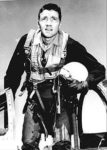
OODA stands for Observe / Orientate / Decision / Action and is a problem solving framework developed by a fighter pilot named John Boyd. The OODA Loop is the sequence that we go through to solve a problem, often in a competitive situation where our competitor is going through their own OODA loop too.  Even if your problem is not as dramatic or life-threatening as fighter pilots trying to shoot down their opponent, the OODA Loop concept and way of thinking can still apply.

The first parts of the OODA loop are Observe and Orientate. As was shown earlier, our Mental Models figure into both how we observe a situation as well as how we orientate to it (or “make sense of the situation”). An incorrect or out-dated mental model can cause us to make (and act on) a bad decision. For a figher pilot, a bad mental model can be fatal.

On the other hand, if we have good mental models we may be able to jump from an Observation directly to Action. This “implicit decision” to react to a pre-determined situation can give you an advantage over your competition, especially if they are still Observing, Orientating and Deciding. By Acting before they do, you essentially are creating a new observation for them and short-circuiting their OODA Loop.

Basketball… for example…

If we are playing Man-to-man defense and the offense does “X”… do we have an “implicit decision” for the “Y” action that we will take? What are your team’s mental model(s) for situations that commonly come up in a game?

What if the competition beats or counters our actions effectively? Do we have a mental model to deal with this new situation? Do we need to adapt or change our mental model? Perhaps by switching from a pressure M2M to one that includes more help defense? Do we back off the M2M or change the match-ups?

Or do we need to develop a completely new mental model for an effective basketball defense? Maybe a zone defense would work better? Or something we have never tried before… ?

Building Mental Models

Whether you are competing on the court or in the corporate boardroom, you should understand how to build new mental models. There are two processes (that I learned from reading about fighter pilot and military strategist Col. John Boyd) which you can use to come up with new mental models… Inductive or Deductive.

Deductive process involves analysis and the breakdown of other mental models into sub-components that can then be re-imagined through the Inductive process. While deductive processes are important to our understanding of both the competitive situation and our options for action it can also lead to paralysis since we can always break things down into smaller and smaller bits which won’t get us closer to a new model and the ability to translate it into action.

Inductive process of building mental models involves creativity and the creation of new combinations or components to build a different mental model. Some combinations will work while others will be discarded. The key is to find something that can be acted upon and tried against the competition.

Where does all this end?

The short answer? Probably never since we are always encountering new competitive or problem-solving situations and must come up with new mental models.

The better answer? When we win. Once we have a mental model that works, we have an advantage in the current competitive situation. We can win.

The bad news (or exciting news, depending on how you look at it) is that things change and a mental model that worked in the past will probably be less effective in the future.

The competition learns… so be ready.

It is good to build a little Uncertainly into your life. Uncertainty keeps you on your toes and helps you be on the lookout for situations where your existing mental models are letting you down. A mind that is open to the idea that you don’t have all the answers will also drive you to continue to learn and prepare for your next competition. (Ideally, you are adapting faster than your competitors.)

Mental Models keep us alive by helping us solve problems. They can also kill us if we are in a dogfight and our mental model is out of date or ineffective.

Are your mental models up to date? What can you learn today so you are ready to build new mental models? If you found the OODA Loop idea interesting, I would recommend reading this post that gets into the concepts that Boyd used to create and implement his OODA Loop idea. It provides more insights related to the use of OODA Loops which can improve your effectiveness as an athlete and in life.

Leave a comment on your Mental Models

Did you find this article useful? What mental model did you explore or change? What problem did you solve by building new mental models? We would love to hear your stories and feedback in the comments below !