3 Simple Basketball Stats to Track if You Want to Win More Games

3 basketball stats to track if you want to win by coach wheeler

Every basketball coach says they want to win. But not every coach tracks the things that actually lead to winning.

That’s where games are often decided — not in the final score, but in the smaller scoreboards running underneath the game.

A football coach might talk about turnover ratio, missed tackles, and explosive plays. Simple. Clear. Connected directly to winning.

So what are the basketball equivalents?

Not complicated analytics that require a full-time video coordinator. Not a spreadsheet with 47 categories nobody looks at after the game. I’m talking about simple basketball stats to track that a high school coach, assistant coach, team manager, or parent volunteer can chart from the bench.

Here are the three numbers that can change a basketball program:

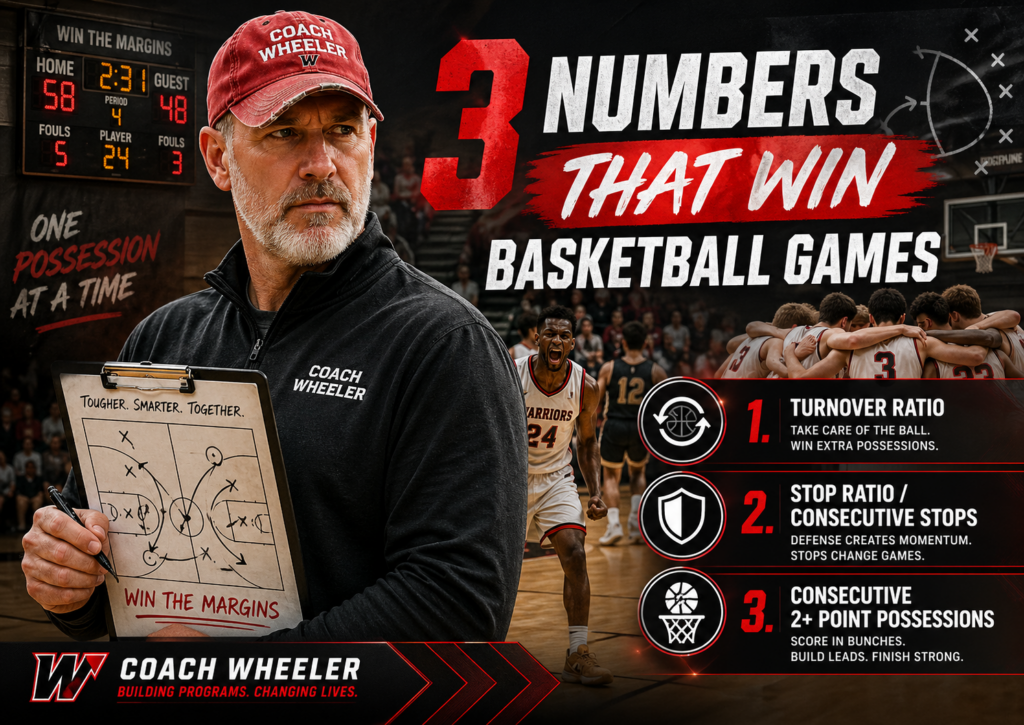
  1. Turnover Ratio
  2. Consecutive Stops and Stop Ratio
  3. Consecutive Possessions with 2 or More Points Scored

These three stats don’t just describe what happened.

They teach your team how to win.

1. Turnover Ratio: Who Won the Possession Battle?

Basketball is a possession game.

Every possession has value. Every careless turnover is a gift. Every forced turnover is an opportunity. That’s why turnover ratio is one of the most important basketball stats to track.

The idea is simple:

Turnover Ratio = Turnovers Forced vs. Turnovers Committed

If we force 18 turnovers and commit 11, we are plus+7.

That means we likely created seven extra opportunities to score. That might be seven extra fast breaks, seven extra chances to get fouled, or seven extra possessions where the other team never even got a shot.

Turnovers matter because they often lead to high-percentage scoring chances for the opponent, especially in transition. Breakthrough Basketball notes that turnovers can create fast-break opportunities and can even contribute to foul trouble.

But this stat is not just about yelling, “Take care of the ball!” That doesn’t coach anybody.

Turnover ratio forces better questions:

Are we making the simple pass?
Are we spacing the floor?
Are we meeting passes?
Are we attacking under control?
Are we creating turnovers with pressure, traps, anticipation, and hustle?

A turnover is rarely just one player’s mistake. Sometimes the passer is late. Sometimes the receiver drifts. Sometimes teammates stand still. Sometimes the player with the ball has no good option because the other four players are watching instead of moving.

That is why turnover ratio is a team stat.

It teaches shared responsibility.

Win the turnover battle, and you give yourself a chance to win the game.

Lose it badly, and you may spend the whole night trying to recover from mistakes you gave away for free.

2. Consecutive Stops and the Stop Ratio:
Can We Break Their Rhythm?

Most teams talk about defense. Winning teams measure it.

A stop means the opponent had a possession and did not score.

That’s it.

They miss and we rebound? Stop.
They turn it over? Stop.
They take a bad shot and we secure the ball? Stop.

They miss, get the offensive rebound, and score? Not a stop.
They miss, get fouled on the rebound, and score at the line? Not a stop.

Defense is not finished when the shot goes up. Defense is finished when we have the ball.

That one sentence can change a team.

There are two defensive numbers I want to track.

The first is consecutive stops.

How many defensive stops can we stack in a row?
Can we get three straight stops?
Can we get four?
Can we get five?

Three stops in a row gives your offense a chance to create separation. Four or five stops in a row can change the emotion of the entire gym.

That’s when the other coach starts pacing.
That’s when the other team starts rushing.
That’s when their best player starts forcing.

That’s when our bench comes alive.

The second number is Stop Ratio.

Stop Ratio = Our Defensive Stops vs. Their Defensive Stops

If we stop them 30 times and they stop us 24 times, we won the stop battle.

That matters.

A team can survive a cold shooting night if it gets enough stops. A team can survive a rough offensive stretch if it refuses to let the other team run away. Defensive statistics like opponent shooting percentage, possessions, turnovers, steals, and rebounding are commonly recommended for understanding defensive performance.

Stop Ratio gives your players a clear mission:

Get the ball back without giving up points.

Not “play harder.”
Not “want it more.”

Get a stop.

Then get another one.
Then another.

This is how defense becomes visible. Players start to understand that a deflection matters. A box out matters. A strong closeout matters. A trap that forces a panic pass matters. A rotation that prevents a layup matters.

The scoreboard only shows points.

Stop Ratio shows the work that prevents them.

3. Consecutive Possessions with 2 or More Points Scored: Can We Build a Run?

Basketball games are often decided by runs.

A 6-0 run.
An 8-2 run.
A 10-0 run that turns a close game into panic.

But runs do not happen by accident.

They happen when one team stacks winning possessions.

That is why the third stat is:

Consecutive possessions with 2 or more points scored.

This is different from just tracking field goal percentage.

A possession with 2 or more points could be:

A layup.
A putback.
Two made free throws.
A three-pointer.
An and-one.
A great offensive possession that ends with a high-value shot.

The point is not just, “Did we shoot well?”

The point is:

Can we score on consecutive possessions and put pressure on the other team?

One made basket is nice.

Three scoring possessions in a row changes the game.
Four can force a timeout.
Five can break belief.

This stat teaches players how to think about offensive efficiency without burying them in advanced terminology. Modern basketball analysis often looks at offensive and defensive efficiency through points per possession or points per 100 possessions, but high school teams can begin with simpler possession-based tracking.

For high school players, “score 2 or more points on this possession” is concrete.

It teaches shot selection.
It teaches attacking the paint.
It teaches getting to the free-throw line.

It teaches offensive rebounding.
It teaches passing up a decent shot to create a better one.
And it teaches the team that offense is not about one player hunting points.

It is about the group creating pressure.

A rushed shot early in the possession may technically be open, but does it help us stack scoring possessions?

A wild drive into three defenders might feel aggressive, but does it produce 2 or more points?

A lazy pass around the perimeter might look like offense, but did we ever make the defense uncomfortable?

Winning offense creates problems.

It forces rotations.
It attacks gaps.
It gets paint touches.

It turns good shots into great shots.
It crashes the glass.
It scores, then gets ready to defend.

The Real Magic:
Stack Stops and Scores Together

The power of these three basketball stats is not that they stand alone.

The power is how they connect.

Force a turnover.

Score 2 or more.

Get a stop.

Score 2 or more.

Get another stop.

Score again.

That is how a game flips.

Not with a miracle.

Not with a speech.

Not with one player trying to save the team.

Games flip when a team stacks winning possessions.

That is the game inside the game.

And once players understand that, they start seeing basketball differently.

They stop thinking only about the final score and start thinking about the next possession.

Can we force a turnover?

Can we get a stop?

Can we score 2 or more?

Can we do it again?

That is winning basketball.

How These Stats Can Help Turn Around a Program

A struggling basketball program does not always need a brand-new identity, a complicated offense, or a miracle group of athletes walking through the door.

Sometimes it needs a simpler scoreboard.

A losing program often has vague problems:

“We need to be tougher.”
“We need to play smarter.”
“We need to compete.”
“We need to stop making mistakes.”
“We need to finish games.”

Those statements may be true, but they are not specific enough to fix.

These three stats make the problem visible.

If the team is losing the turnover battle, start there.

If the team cannot get three stops in a row, start there.

If the team cannot put together three scoring possessions in a row, start there.

Now practice has purpose.

Film has purpose.

Players have targets.

Assistant coaches have language.

Parents can understand what the team is trying to build.

And the program starts shifting from “hoping to win” to training the behaviors that produce winning.

That matters.

Especially in a program that has been losing.

Because belief does not come from pretending everything is fine.

Belief comes from proof.

When players see that they forced 20 turnovers, got four stops in a row twice, and stacked three scoring possessions in the third quarter, they can feel progress.

Even before the record fully changes, the identity starts changing.

That is how turnarounds begin.

One measurable behavior at a time.

How to Track These Basketball Stats During a Game

You do not need a complicated system.
Use a clipboard.
Create three sections.

Turnover Ratio

Track:

Our turnovers
Their turnovers
Plus/minus difference

Goal: win the turnover battle.

Consecutive Stops / Stop Ratio

For each opponent possession, mark:

S = Stop
P = Points allowed

Circle every streak of three or more stops.

At the end of the game, compare our stops to their stops.

Goal: win the Stop Ratio and create multiple stop streaks.

Consecutive Possessions with 2+ Points

For each offensive possession, mark whether we scored 2 or more points.

Circle streaks of three or more.

Goal: create scoring runs by stacking productive possessions.

This is simple enough for a manager, assistant coach, or injured player to track.

More importantly, it is simple enough for players to understand.

How to Build These Stats Into Practice

Do not just track these numbers in games.

Train them.

Run a defensive drill where the team must get three stops in a row before switching.

Run a scrimmage where turnovers are minus-two points.

Run a scoring challenge where the offense must score 2 or more points on three straight possessions.

Run a “Win the Ratio” segment where the only thing that matters is stops compared to scores.

Put the numbers on the board.

Talk about them before games.

Review them after games.

Celebrate the players who create them.

Because players repeat what gets recognized.

If we only celebrate points, players chase points.

If we celebrate stops, deflections, smart passes, strong catches, rebounds, paint touches, and winning possessions, players start chasing winning.

That is the shift.

The Bottom Line

Let’s be real… The final scoreboard matters.
But the final scoreboard is usually the result of smaller scoreboards running all game long. The turnover scoreboard. The stop scoreboard. The scoring-streak scoreboard.

Win those, and you give yourself a real chance to win the game.

These are not just stats.
They are teaching tools.
They are culture tools.
They are turnaround tools.

They help players understand what winning actually requires.

  • Take care of the ball.
  • Get the ball back.
  • Score with purpose.
  • Do it again.

That is not complicated.

But it is powerful.

Winning is not magic.

Winning is measured.

Winning is trained.

Winning is built one possession at a time.

Let’s Roll.

The Winning Mindset Playbook by Coach Dave Wheeler

Ready to start developing the habits that actually lead to winning? Download the free Winning Mindset Playbook and start building the confidence, discipline, toughness, and daily standards that turn effort into results.

Whether you’re a player, coach, parent, or leader, this playbook gives you a practical starting point for training the mindset behind better decisions, stronger habits, and bigger wins — one possession, one practice, one step at a time.

Coach Wheeler’s Challenge Philosophy: 104 Basketball Practice Challenges That Build Winning Teams

Basketball Challenge Practice Intensity Drill

Stop running drills. Start demanding proof. Walk into most gyms and you’ll see good work. Lines are tight. Drills are organized. Coaches are talking. And then the game hits… and it disappears. I’ve lived that. So I made a shift—not in plays, not in schemes… In how we train. It is called “basketball practice challenges”


XPLAIN: What This Really Is

A drill tells players what to do. A challenge asks:

“Can you prove it… right now… when it matters?”

That’s the difference.

  • Drills create activity
  • Challenges create accountability
  • Drills build comfort
  • Challenges build capacity
  • Drills look good
  • Challenges translate

If it’s not tested, measured, and proven…

It’s just talk.


What Happens When You Flip the Switch

The moment you introduce real challenges, your gym changes.

Effort becomes visible

No guessing. It’s timed. It’s scored.

Focus sharpens

Standards replace speeches.

Accountability shows up

The board tells the truth.

Confidence gets earned

Not hype—proof under pressure.


XAMPLE: Same Drill. Different Team.

Full-court sprints.

Old way: “Run 10.”

Challenge way: “10 sprints. Every rep under 6 seconds. Miss one—we restart.”

Now:

  • Teammates hold each other accountable
  • Standards get protected
  • Nobody hides

Same drill. Different identity.


Why You Need This

Games don’t care what you practiced. They ask:

  • Can you execute when tired?
  • Can you think when it’s chaotic?
  • Can you respond after a mistake?
  • Can you win when it’s uncomfortable?

If your practices don’t ask those questions… The game will.


🔄 XCHANGE: How We Build It Through the Season

This isn’t random. It’s layered.


Early Season — Build the Engine

Physical Challenges

We go heavy here:

  • Timed sprint standards
  • Rebounding battles
  • Shooting volume competitions

Example:

“1-minute layup challenge—team must hit 25 or we reset.”

You’re building capacity.


Mid-Season — Lock the Mind

Mental Challenges

Now we stress focus:

  • Pressure free throws (with consequences)
  • Silent scrimmages
  • “Next play” response challenges

Example:

“Miss 2 free throws as a team—everyone runs.”

You’re building discipline.


Late Season — Win the Moment

Game Situation Challenges

Now it’s real:

  • Down 3, 30 seconds
  • Up 2, need a stop
  • BLOB/SLOB execution

Example:

“You’re down 2. 18 seconds. No timeout. Solve it.”

You’re building execution.


All Season — Control What Matters

Control Challenges

Daily identity work:

  • Sprint to huddle
  • No negative body language
  • Talk every possession

Example:

“Zero hands on hips all practice—or we redo the last drill.”

You’re building culture.


⚙️ How I Run It

Simple. Every practice:

At least one challenge… Physical, Mental and Game or Control

usually less than 10–15 minutes.

Track it. Post it. Name winners.


Get the Full System (104 Challenges)

What you just read is the philosophy.

But philosophy without structure… fades.

That’s why I built:

The Coach Wheeler Challenge Philosophy eBook: with 104 Challenges

Inside, you get:

All 4 Categories Fully Built Out:

  • 26 Physical Challenges (timed, competitive, measurable)
  • 26 Mental Challenges (focus, discipline, response)
  • 26 Game Situation Challenges (real-game execution)
  • 26 Control Challenges (effort, energy, culture)

Real Examples You Can Run Tomorrow:

  • “Win the Drill Twice” (consistency pressure)
  • “3 Stops in a Row” (defensive identity)
  • “Clutch Free Throw Ladder” (pressure shooting)
  • “No Walk Practice” (effort standard)
  • “Down 3, 30 Seconds” (game reality)

Each one is designed to:

  • Be simple to implement
  • Create immediate buy-in
  • Produce visible results

Final Thought

You don’t need more drills. You need more proof.

Because at some point, your team will face a moment where:

  • It’s tight
  • It’s loud
  • It’s uncomfortable

And they won’t rise to what you said. They’ll fall back on what they’ve proven.


“Did we prove it today?”

If you want that answer to be yes

👉 Grab the Challenge Philosophy eBook including 104 Challenges for Highly Competitive Basketball Teams (the link will be added here when it is released or you can simply sign up for Coach Wheeler’s email list) and start building a team that doesn’t hope to win— They expect to.


And here’s where it gets even better…

These 104 challenges are also being turned into two card decks:

  • One for Physical + Game challenges
  • One for Mental + Control challenges

So you can literally pull a challenge and run it on the spot.

Plus:

  • Practice integration system
  • Tracking ideas
  • Seasonal progression plan

Wheeler Hole Theory

Digging Your Way to Success by Building Your Mountain

Ask me about Wheeler Hole Thedory

At the heart of personal development and peak performance lies a simple but powerful truth—success is built from the ground up, often from a place of struggle. This article introduces the Wheeler Hole Theory, a metaphorical framework developed by Coach Wheeler to illustrate how overcoming challenges and pushing through obstacles is directly tied to the heights you will eventually reach. Just as you dig through your personal hole to lay a foundation, every effort, every challenge you overcome, contributes to building your mountain of success.

What sets this theory apart is the idea that every shovelful of dirt you remove from your hole is added to the top of your mountain. The effort you put in to dig out of your current circumstances doesn’t disappear; it elevates you, adding directly to the foundation of your success. The deeper you dig, the taller your mountain becomes. Each step, each moment of preparation, builds toward the summit of your achievements.

The Hole You Dig

In Wheeler’s theory, your “hole” serves as the starting point—where you are right now, facing your current limitations, doubts, or lack of skills. It’s the beginning of your journey, a place where you may feel stuck or even buried under the weight of challenges ahead. The good news is that you are standing on the ground that will make your mountain of success even higher. It’s probably the only time you will start at the top… of your hole… as you dig your way to success.

“The man who moves a mountain begins by carrying away small stones.” – Confucius

What Determines the Depth of Your Hole?

Your hole represents everything that currently holds you back:

  • The skills you haven’t mastered.
  • The knowledge you haven’t acquired.
  • The obstacles or mental blocks that hinder progress.
  • Basically, everything that you need to overcome to become a success, no matter how you might define it.

Here’s the catch: everyone has a hole to dig out of, no matter how successful they seem. Even the most accomplished individuals started from a point of struggle, a place where they had to put in the effort to climb out.

This is where Wheeler’s idea shines: every effort you make to dig out of your hole doesn’t go to waste. Instead of simply removing dirt, you’re adding it to the top of your mountain—your ultimate achievement.

The Effort of Digging:
Boulders or Breakthroughs?

As you dig, it’s not always going to be easy. You’re bound to encounter boulders—major obstacles that feel immovable at times. These boulders might be skill gaps, self-doubt, or external challenges like lack of resources or time. But instead of viewing them as impediments, Wheeler Hole Theory challenges you to see these boulders as breakthroughs in disguise.

The more you dig, the stronger you get. As you move the dirt and face the boulders, you also build your mountain of success. Every ounce of effort adds to the summit you’re creating. The deeper you dig, the higher your mountain grows. The more resistance you face, the more preparation you amass to climb higher than you ever thought possible.

Grow your grit by applying the Wheeler Hole Theory

In essence, the tougher the dig, the taller your mountain. When you encounter a seemingly immovable boulder, that’s your opportunity to uncover new strengths, develop new skills, and reveal talents buried beneath the surface. Author Angela Duckworth calls this quality “GRIT” (check out her book… it has some inspirational ideas for you too.)

Unearthing Hidden Talents

Digging through your hole isn’t just about getting rid of what’s in your way. It’s also about discovering new strengths and uncovering hidden potential. Many of the talents you never realized you had may be buried beneath the surface, waiting to be unearthed. And just like the soil you dig up, these talents don’t disappear—they are what help you build your mountain.

This shift in perspective is crucial. Rather than seeing the digging as pointless or overwhelming, you start to realize that every obstacle is a chance to improve. Every shovelful of dirt you remove not only frees you from your limitations but also raises the height of your mountain, bringing you closer to your goals.

The Connection Between
Effort and Elevation

Wheeler Hole Theory introduces you to a profound concept: the effort of digging out of your hole is directly connected to how high you’ll eventually climb. Every step forward in preparation, every skill you build, every mental block you overcome adds to the mountain you’re building beneath your feet.

Your success isn’t just a result of what you do when you reach the surface—it’s built on the accumulation of all the effort you put in during the climb out of your hole. This metaphor reinforces the idea that nothing is wasted. The harder you dig, the higher you go.

Champions Find a Way to Keep Digging

Wheeler’s theory also emphasizes that most people give up too soon. They may dig for a while, face a particularly tough boulder, and then stop—thinking that it’s not worth the effort. But here’s the key: champions keep digging, even when it feels like they’re getting nowhere. They understand that every moment spent moving dirt, chipping away at obstacles, is building the foundation for their eventual success.

There are countless examples of this in real life. Think of athletes like Serena Williams or Michael Jordan. Their success wasn’t a result of one massive effort but rather a collection of daily struggles and victories. Every practice, every missed shot, every setback became a part of the mountain they climbed to reach greatness.

“Effort only fully releases its reward after a person refuses to quit.”Napoleon Hill, author of Think and Grow Rich

Navigating Challenges:
Quitting Doesn’t Mean Failing

Even when the digging gets tough, it’s important to understand that taking a break isn’t the same as quitting. Wheeler’s theory teaches us that knowing when to step back and rest is critical. Champions take strategic breaks, not to abandon their goals but to come back stronger, refreshed, and with new insight into how to keep moving forward.

The ability to pause, reflect, and return with greater energy is what separates those who succeed from those who give up. As the saying goes, “Rest if you must, but don’t quit.” You can return to the hole the next day with renewed strength, ready to dig deeper and continue adding to the top of your mountain.

Building Your Mountain of Success

As you continue to dig out of your hole, you’re simultaneously building something grander—a mountain of success that grows with every bit of dirt you remove. This mountain is built on preparation, perseverance, and effort.

Your Mountain Reflects Your Journey

The mountain you build isn’t just a symbol of success; it’s a reflection of your journey. It represents every lesson learned, every skill acquired, and every moment of mental toughness. And as you climb higher, you’ll look back and see just how far you’ve come.

The height of your mountain is determined by how much effort you’re willing to put in. The more shovelfuls you remove from your hole, the greater the heights you’ll reach. This concept not only motivates us to keep going but also reframes our perspective on challenges. Every obstacle is an opportunity to build our mountain higher.

Preparation Leads to Elevation

Success doesn’t happen overnight, and there are no shortcuts to the top of your mountain. Wheeler Hole Theory reminds us that success is earned, not granted, and it’s earned through the act of preparation. The digging you do today—no matter how difficult—lays the groundwork for the heights you’ll achieve tomorrow.

Each shovelful of dirt is an investment in your future, adding to the mountain you’ll one day stand upon. As you continue to dig, remember that your efforts are not wasted. They are elevating you, building something incredible with every step forward.


Remember:
Digging and Building Are One Process

I am diggin it... Wheeler Hole Theory

The Wheeler Hole Theory provides a simple yet profound framework for understanding success. It teaches us that every bit of effort we put into overcoming our current limitations directly contributes to the success we’ll achieve in the future. Digging out of our hole isn’t just about breaking free from our struggles—it’s about building the mountain of success we’ll one day stand on.

So as you reflect on your own journey, ask yourself: Are you willing to dig deep enough? Are you prepared to face the boulders, knowing that each obstacle moves you higher? Every shovelful you dig from your hole adds to the top of your mountain. Keep going, and soon enough, you’ll reach the summit.

Need more inspiration before you start applying the Wheeler Hole Theory in your life? Check out Coach Wheeler’s article titled, Embrace The Grind.

How to become an Elite Warrior

Your Path to Unstoppable Grit and Success

What does it mean to think like an elite warrior?

Elite Warrior Mindset

It’s not just about strength, skill, or talent. It’s about mindset—the unshakable discipline, mental toughness, and relentless drive that allow you to rise above adversity. It’s about controlling emotions, adapting under pressure, and refusing to accept mediocrity.

The good news? You can develop this mindset.

No one is born with an elite warrior mentality. It is built—through action, discipline, and daily choices. If you are ready to forge mental toughness and unstoppable willpower, this guide will show you how to train each of the 10 Core Tenets of the Elite Warrior Mindset (that you probably learned about from a previous article on this blog).


1. Build Unshakable Discipline:
Train Consistency Over Motivation

“Discipline is the bridge between goals and accomplishment.”
— Jim Rohn

Discipline is what separates those who dream from those who achieve. It’s the ability to execute, day in and day out, regardless of circumstances. Warriors don’t wait until they “feel like it” — they just do it.

How to build it:

  • Create daily non-negotiables. Build habits that you follow no matter what—wake up at the same time, train every day, complete your priorities before anything else. Make it who you are, not something you “try to do.”
  • Eliminate decision fatigue. Have a set morning routine, eat the same breakfast, wear similar clothes. The fewer trivial decisions you make, the more energy you save for important tasks.
  • Hold yourself accountable. Set up consequences for breaking discipline—a cold shower, extra reps, a loss of privilege. If there’s no consequence for skipping, your discipline will crumble.

2. Develop Mental Toughness Under Pressure: Thrive in the Storm

“If you can keep your head when all about you are losing theirs… yours is the Earth and everything that’s in it.” — Rudyard Kipling

Pressure is a privilege—it means you’re in the arena. The difference between the weak and the elite is that warriors remain calm when others panic.

How to build it:

  • Train in adversity. Push yourself through brutal workouts, fast for a day, take cold showers—seek controlled hardship so that when real adversity strikes, you’ve already conquered worse.
  • Simulate pressure situations. Practice your craft in high-stakes scenarios—shoot free throws when you’re out of breath, speak in front of a crowd, put deadlines on projects. Train like it’s game day.
  • Master your self-talk. Pressure is mental. Instead of saying, “I can’t handle this,” say, “I was made for this.” Reframe stress as energy that fuels peak performance.

3. Take Extreme Ownership:
Accept Full Responsibility for Everything

“The moment you take responsibility for everything in your life is the moment you can change anything in your life.” — Hal Elrod

Excuses are the language of mediocrity. Ownership gives you power. Warriors don’t blame teammates, circumstances, or luck—they focus on what they can control and fix it.

How to build it:

  • Eliminate blame from your vocabulary. If something goes wrong, own it. Ask: What could I have done differently? Weak people blame others—warriors seek solutions.
  • Lead yourself first. If you can’t lead yourself with discipline, no one will follow you. Take charge of your habits, training, and mindset.
  • Make accountability public. Tell others about your goals. The more eyes on you, the less likely you are to make excuses.

4. Cultivate Resilience & Adaptability:
Bounce Back Stronger

“Do not pray for an easy life; pray for the strength to endure a difficult one.” — Bruce Lee

Failure isn’t final—it’s feedback. Elite warriors see setbacks as fuel for their next victory.

How to build it:

  • Adopt the ‘Next Play’ mentality. Whether you fail a test, lose a game, or get rejected, move on immediately. Ask: What’s next? The past is irrelevant—your next action is what counts.
  • Expect adversity. Don’t be surprised when things go wrong—be ready. See struggles as part of the process, not a sign to quit.
  • Stay solution-focused. Instead of dwelling on problems, ask: What’s the best move I can make right now? Adapt and execute.

5. Develop a Relentless Work Ethic:
Outwork Everyone

“Success isn’t owned, it’s leased. And rent is due every day.”
— J.J. Watt

How to build it:

  • Prioritize effort over talent. Hard work beats talent when talent doesn’t work hard. Warriors focus on consistent effort rather than short bursts of motivation.
  • Schedule your grind. Block off dedicated time every day for skill development, conditioning, or self-improvement. Treat it like an unbreakable appointment.
  • Measure progress aggressively. Track your workouts, study hours, reps, and results. Set clear, measurable targets and beat them.

6. Train Situational Awareness & Strategic Thinking: Stay Three Steps Ahead

“The supreme art of war is to subdue the enemy without fighting.” — Sun Tzu

How to build it:

  • Study your environment. Know the game better than anyone. Review film, analyze competition, study trends—train your mind to recognize patterns.
  • Think long-term. Short-term gratification kills long-term success. Warriors think in years, not minutes.
  • Adapt quickly. If your plan fails, pivot immediately. Never freeze when things don’t go as expected.

7. Harness Calculated Aggression:
Know When to Strike

“The best time to plant a tree was 20 years ago. The second best time is now.” — Chinese Proverb

How to build it:

  • Train explosive decision-making. Speed matters. Simulate situations where you must react fast under pressure.
  • Strike at the right moment. Over-aggression burns energy. Learn when to wait and when to go all in.
  • Act boldly, even when uncertain. Warriors don’t hesitate. They trust their preparation and make decisive moves.

8. Master Emotional Control & Stoicism:
Stay Unshaken

“A wise man will be master of his mind, a fool will be its slave.”
— Publilius Syrus

Elite warriors don’t let emotions dictate actions—they stay calm under fire.

How to build it:

  • Pause before reacting. Before you respond, take a deep breath. Learn to act with logic, not emotion.
  • Expose yourself to discomfort. When you control your response to stress, you control your mind.
  • Focus only on what you can control. If it’s out of your hands, let it go.

9. Develop Unshakable Confidence:
Believe in Yourself

“He who conquers himself is the mightiest warrior.” — Confucius

How to build it:

  • Back confidence with preparation. You earn confidence by doing the work—train harder than anyone, and your belief in yourself will be unshakable.
  • Destroy negative self-talk. Change “I hope I can” to “I will.” Speak with conviction.
  • Visualize winning daily. If you can see it in your mind, you’ll make it happen in real life.

10. The Will to Win:
Refuse to Accept Mediocrity

“You must expect great things of yourself before you can do them.” — Michael Jordan

How to build it:

  • Refuse average effort. Do everything at the highest level—no half-measures.
  • Surround yourself with winners. The company you keep determines your mindset.
  • Cut out negativity. Make winning your standard.
    Winners don’t participate—they dominate.

Are You Ready to Train Like an Elite Warrior?

Developing an Elite Warrior Mindset isn’t easy—but it’s worth it.

If you want to become an Elite Warrior, you have a choice…
Every day, you have a choice: live like everyone else or rise like a warrior.

Which will you choose?

It starts today. Train discipline. Train resilience. Train to win.

Become an Elite Warrior!

Responsibility and Hard Work

The Surprising Connection Between Responsibility and Hard Work:
A Journey Toward Fulfillment

In contemporary society, responsibility and hard work often go hand-in-hand. But what is the underlying connection between these two concepts? How does one complement the other, and why is their marriage more significant than merely fulfilling an obligation? Let’s explore how responsibility and hard work intertwine to pave the way for personal growth, success, and the realization of dreams.

Responsibility: More Than an Obligation

Responsibility goes beyond fulfilling duties or adhering to societal expectations. It’s a deeply personal commitment to take charge of one’s life, to align actions with values, and to pursue goals with determination and integrity.

Theodore Roosevelt once said, “With self-discipline, most anything is possible.” This underscores the idea that responsibility requires an inner commitment that drives us to act diligently and purposefully.

Hard Work: The Fuel for Responsibility

Hard work is the energy that propels us toward achieving our responsibilities. It’s the time, effort, and perseverance needed to realize our goals and bring our visions to life. Hard work is not just about the grind; it’s about being engaged, persistent, and resilient in the face of challenges.

Thomas Edison aptly expressed, “Genius is 1% inspiration and 99% perspiration.” The idea here is that achieving anything meaningful requires consistent and determined effort.

Responsibility and Passion:
A Symbiotic Relationship

What makes hard work and responsibility so intertwined is the passion that fuels them. When we take responsibility for something we genuinely care about, the hard work becomes not just an effort but a joyful pursuit.

Whether it’s a career goal, personal development, or a creative project, aligning responsibility with our passions turns the journey into a fulfilling adventure.

Cultivating Habits:
Building Blocks of Success

Taking responsibility and committing to hard work also means cultivating habits that align with our goals. These habits act as the building blocks of success, allowing us to approach challenges with grace and to grow continually.

Aristotle wisely stated, “We are what we repeatedly do. Excellence, then, is not an act, but a habit.” By forming habits that reflect responsibility and hard work, we shape our character and our destiny.

Charles Duhigg, in his book “The Power of Habit,” outlines how habits can be understood and transformed through a three-step loop: cue, routine, and reward. Identifying the cue that triggers a habit, then consciously choosing a routine that aligns with our values, and finally reinforcing it with a positive reward helps in making desired changes.

In the context of responsibility, it’s essential to recognize the habits that either support or hinder our progress and act accordingly. Perhaps the cue is a sense of obligation towards a particular goal; the routine could be the diligent and consistent effort applied, and the reward could be the satisfaction and growth resulting from achieving milestones.

Understanding and harnessing this framework empowers us to create new habits that resonate with our objectives and values. By nurturing habits that embody hard work and align with our responsibilities, we are not just building a solid foundation for success but also paving a path towards a more intentional and fulfilling life.

Growth and Success:
The Fruits of the Journey

The combination of responsibility and hard work leads to personal growth and success. By taking charge of our lives and investing effort in our pursuits, we expand our horizons, develop new skills, and realize dreams that might have seemed unattainable.

Colin Powell said, “A dream doesn’t become reality through magic; it takes sweat, determination, and hard work.” This encapsulates the transformative power of responsibility and hard work, turning aspirations into tangible achievements.

Real-Life Applications

In Careers: Taking responsibility for career development and putting in hard work leads to professional growth, satisfaction, and success.
In Relationships: Being responsible for our actions and working hard to maintain and nurture relationships leads to deeper connections and trust.
In Personal Development: Taking personal responsibility for growth and working hard to achieve self-improvement leads to a more fulfilled and enriched life.
In Sports: The arena of sports offers a vivid illustration of how responsibility and hard work can lead to phenomenal success. Athletes demonstrate clearly that taking personal responsibility for one’s growth and putting in the necessary hard work can lead to mastery and achievement. It’s a testament to how individual commitment can translate into collective triumph.

One quintessential example of the symbiosis between responsibility and hard work is the story of basketball legend Kobe Bryant. Known for his relentless work ethic, Kobe would often arrive hours before practice and stay long after it was over. His commitment to constant improvement and taking personal responsibility for his game made him one of the most outstanding athletes of his generation. Kobe’s approach wasn’t merely about hard work; it was about aligning that work with a clear vision and a deep sense of responsibility to himself, his team, and the game of basketball.

Similarly, Michael Jordan, another basketball great, often attributed his success to the relentless pursuit of excellence. He believed in embracing failure as a pathway to growth, putting in the hard work and taking responsibility for each step of his journey. Jordan’s dedication and resolve inspire countless individuals to approach their passions and responsibilities with a similar mindset.

These examples emphasize that the combination of responsibility and hard work isn’t confined to any particular domain. It’s a universal principle that can be applied across various aspects of life, and when embraced wholeheartedly, it leads to growth, fulfillment, and the realization of dreams and potentials. Whether in our careers, relationships, personal development, or sports, the key lies in aligning our actions with our values and putting in the dedicated effort to make our goals a reality.

What drives Responsibility >> Success?

The connection between responsibility and hard work is profound and multi-dimensional. It’s not merely about fulfilling obligations but about embarking on a journey filled with discovery, growth, and fulfillment.

When we align our responsibilities with our passions, values, and goals, the hard work becomes not a burden but an exciting and purpose-driven pursuit. It’s a journey filled with challenges and triumphs, growth and fulfillment, and above all, the joy of realizing our dreams and potentials.

Responsibility and hard work are partners in the dance of life, leading us toward a path of success and self-actualization. Are you ready to embrace this partnership and set out on a journey towards your dreams? The path is open, and the adventure awaits.

Comments on Responsibility and/or Hard Work…

Please leave us a comment with your thoughts on this article. Did it help you? Was it missing something? Do you have a great story about how you applied the ideas of Responsibility and Hard Work? Let us know in the comments.

If you missed the first article in this series, The Power of Response-ability, check it out at this link. Coach Wheeler also talks about Responsibility vs. Blame in this article. If you enjoyed any of these articles, be sure to follow Coach Wheeler on Facebook so that you will be notified when the next post drops!