
Why Give Up?

What the Hard Road Can Teach Us
I let my teaching license expire on purpose. At the time, it made sense.

I had spent several years trying to find the right combination of teaching and coaching. I could teach math. I could teach science. I could coach basketball. What I could not seem to find was a school that needed all three at the same time.

Eventually, I stopped putting time and money into a temporary licensing path without knowing whether the job I wanted would ever appear.
Then it did.

That has a way of making you revisit an old decision.
Did I give up on teaching?
I don’t think so.

I stopped pursuing one route when it no longer seemed to be leading anywhere. Now the circumstances have changed, and I have another decision to make.

I can defend the old choice. Or I can build a new path forward.
That is the problem with the phrase give up.

It sounds simple. Someone starts something. It gets hard. They quit.
Case closed.

Real life is rarely that clean. Sometimes we quit too soon. Sometimes we hang on too long. Sometimes the goal is still right, but the plan has stopped working.

And sometimes the thing we most need to give up is the excuse that keeps us from doing the harder work.

Never Quit
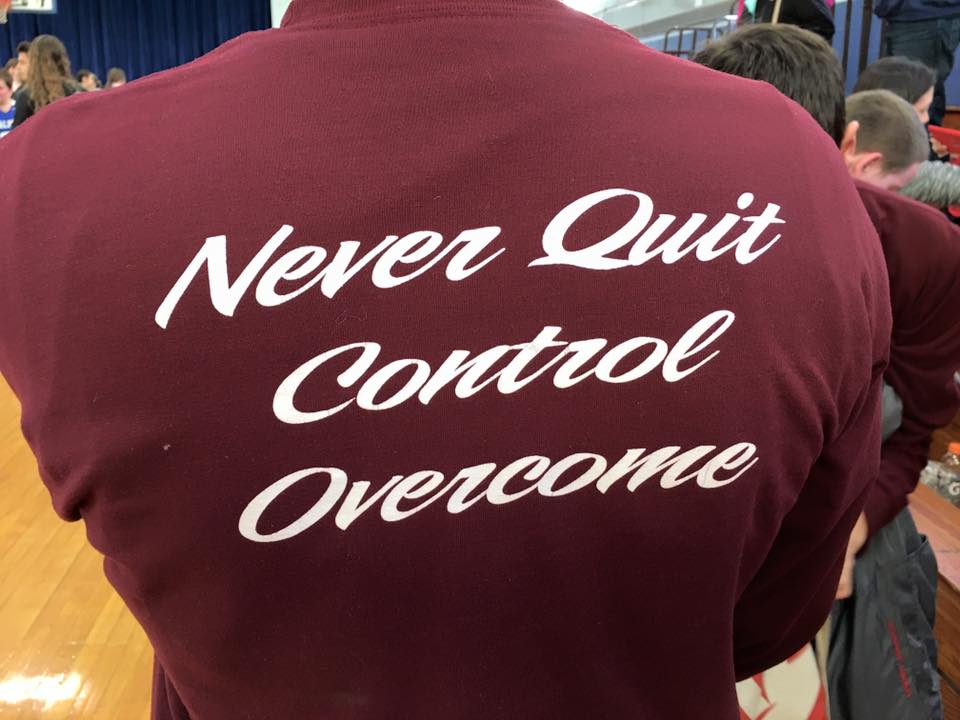
Never Quit, Control Emotions, Overcome Challenges

“Never Quit” was one of the three guiding principles I used during my first two years of coaching. Those teams went 37-3.

Never Quit did not mean we expected every shot to fall or every call to go our way. It meant we stayed connected to the next thing we could do.

Get back on defense. Set the screen. Make the extra pass. Box out. Talk. Compete.

We were not going to let one bad possession turn into three. We were not going to decide that a stronger opponent had already beaten us. We were not going to spend the game collecting reasons we could not win.

The scoreboard mattered, but our response to it mattered more.

Those teams learned that games can change quickly when one group keeps looking for answers while the other begins accepting the result.
That lesson stayed with me.

Unfortunately, knowing a lesson and applying it under pressure are not always the same thing.

The Hard Road

At my most recent coaching stop, we began the season 6-2. We had some early success. Confidence was growing. There were signs that we could become a good team. Then we reached what I call the Hard Road.

The schedule got tougher. We played multiple road games against the best teams in the conference. Our weaknesses became harder to hide. We continued beating teams with worse records. We did not beat the top teams.

That was disappointing, but it was not the biggest problem. The biggest problem was how we responded.

We began building explanations. “The schedule was difficult.” “The matchups were bad.” “Other teams had more experience, more depth or better athletes.” Some of those things were true. They were also useless unless they pushed us toward better preparation.

Instead, we began doing what I call arguing for our limitations.

When you argue for your limitations, you become very good at proving why you cannot succeed. You collect evidence. You repeat the explanation.

You turn every setback into confirmation that the opponent is too strong, the situation is unfair or the answer is outside your control. Eventually, the limitation becomes part of the team’s identity which is incredibly dangerous if you want to build winners.

That is where there was too much quit and not enough learning. We did not quit the season. We kept practicing. We kept playing. But there are quieter ways to give up.

You can give up on finding another answer. You can accept a weakness instead of attacking it. You can continue showing up while mentally surrendering to the same result.

That kind of quitting is harder to see because everyone is still wearing the uniform.

The Buck Stops Here

As the coach, I take responsibility for my part in that. There were many factors involved. There always are.

Players have different levels of experience, confidence and commitment. Injuries happen. Schedules matter. Team chemistry matters. School circumstances matter. A coach can spend a lot of time explaining all of it.

But the buck stops here.

My job was not simply to recognize that we had reached the Hard Road. My job was to help us use it.

I needed to challenge the excuses earlier. I needed to create more demanding practices before the schedule exposed us. I needed to make the difference between an explanation and an excuse unmistakably clear. I needed to help our players see strong opponents as information rather than judgment.

Most of all, I needed to make sure Never Quit did not become a slogan we repeated while continuing to make the same mistakes.

Persistence without adjustment is not toughness. It is stubbornness.

That season changed how I think about coaching. The moment a team begins arguing for its limitations is the moment the coach has to change the conversation.

Not with a speech alone. With better teaching. Better questions. More competitive practices. Clearer standards. More honest film sessions.

And a plan that turns weaknesses into work.

What Are You Giving Up?

There are a lot of ways to give up.

  • A player can give up after missing two shots.
  • A team can give up after an opponent makes a run.
  • A coach can give up on a player because teaching them has become frustrating.
  • A program can give up on accountability because enforcing standards creates conflict.

You can also give up the right things.

  • You can give up excuses.
  • You can give up protecting your ego.
  • You can give up a strategy that is not working.
  • You can give up the need to look like you were right all along.

That last one matters. Players know when something is not working.

Pretending otherwise does not make a coach look strong. It makes the next adjustment harder to trust.

Sometimes leadership means saying:

  • I did not prepare us well enough for that.
  • That decision was mine.
  • We need a different approach.
  • Here is what we learned.
  • Here is what we are doing next.

Accountability does not weaken authority. It earns credibility.

What “Never Quit” Really Means

Successful people do not refuse to quit everything.

They quit bad habits. They quit ineffective plans. They quit wasting practice time. They quit protecting weaknesses from exposure. They quit repeating drills that look organized but do not transfer to games. They quit assuming that what worked with one team will automatically work with the next.

What they do not quit is the larger purpose.

For a coach, that purpose includes winning. A varsity team should prepare and compete with the expectation that winning matters. But the work goes deeper than the final score.

Basketball gives players repeated opportunities to respond under pressure. A shot does not fall. What happens next? A teammate makes a mistake. Does the group divide or reconnect? The opponent makes a run. Does the team panic or execute? The season becomes difficult. Does the group explain why success is unlikely, or does it get curious about what success now requires?

Those habits travel. They show up in classrooms, jobs, relationships and hard seasons that arrive long after the final buzzer.

That is why coaching matters… at least for me.

Starting Again

I let my teaching license expire because the path no longer appeared connected to a real opportunity. Now, luckily, I have reason to reconsider it.

I could use the old decision as an explanation for why returning would be difficult. Or I could treat the new circumstances as new information.

That does not mean the original decision was foolish. It means the next decision should not be controlled by pride.

Sometimes starting again is not an admission that you never should have stopped. It is proof that the goal still matters.

The same is true in coaching.

I cannot change what happened at my last stop. I can take responsibility for it. I can study it. I can become better because of it.

My early teams showed me what can happen when winning habits become part of the culture. My last team reminded me that those habits do not carry over automatically. I cannot assume they are even understood. I cannot inherit them.

I cannot talk them into existence. They have to be taught, tested under pressure and reinforced every day. Eventually, they have to belong to the players.

That is the difference between having a team that just follows a coach and building a program that knows how to respond when the road gets hard.

Why Give Up?

Seriously . . . Why should you give up?

Maybe the goal is wrong. Maybe the price is too high. Maybe the plan has failed. Maybe continuing would be little more than stubbornness.

But before walking away, there are better questions to ask.

What have we learned?
What can we change?
What are we willing to work on?
What excuse have we allowed to become part of our identity?

What happens if we stop arguing for our limitations and start preparing to overcome them?

There are things worth quitting.

  • Quit the excuse.
  • Quit blaming the schedule.
  • Quit waiting for confidence before doing the work that creates it.
  • Quit treating strong competition as proof that you do not belong.
  • Quit believing that your current limitations get the final vote.

But do not quit on the work simply because the road has become hard.

That may be the point where the real work finally begins.

Hard Season Survival Guide by Coach Wheeler
Get a free download of the Hard Season Survival Guide by Coach Wheeler

The Hard Road will expose what is missing. The question is whether you will defend the limitation or do the work to change it. Explore more practical tools for navigating difficult seasons in Coach Wheeler’s free Hard Season Survival Guide.

How People Become Unstoppable

There is a version of “unstoppable” that gets sold online that I don’t trust.

Become unstoppable during the unseen hours

It is usually loud.
It is usually polished.
It usually looks like somebody who never doubts, never breaks, never gets tired, never questions the path, and never has to drag themselves through a hard day.

That is not unstoppable. That is performance.

Real unstoppable people are not made of steel. They still get hurt. They still lose confidence. They still have moments when the plan falls apart and the future gets quiet.

The difference is not that life never knocks them down. The difference is that they learn how to return.

That is the part most people miss.

Unstoppable is not a personality type. It is not a motivational mood. It is not something you either have or do not have. It is trained. And often, it is trained in the exact moments when you would rather disappear.

Unstoppable People Do Not Wait to Feel Ready

Most people give their emotions too much authority.

They wait to feel motivated before they move. They wait to feel confident before they take the shot. They wait to feel clear before they decide. They wait to feel inspired before they create.

The problem is that feelings are weather. Some days they help. Some days they do not.

If your entire future depends on waking up in the right emotional climate, you are going to be inconsistent.

Unstoppable people still have emotions. They just do not let emotion have the final vote. They build standards.

A standard is different from a goal. A goal says, “I want to write the book.”
A standard says, “I write today.”

A goal says, “I want to be a better athlete.”
A standard says, “I train when nobody is impressed.”

A goal says, “I want to lead.”
A standard says, “I tell the truth even when it would be easier to be liked.”

That is where things start to change.

You do not become unstoppable because every day feels powerful. You become unstoppable because your behavior is no longer controlled by whether the day feels powerful. There is a kind of freedom in that. You stop asking your mood for permission. You have an identity built in that is unstoppable!

Pressure Becomes Information

Pressure has a way of revealing what we would rather not see. That is why we resist it.

Pressure exposes weak habits.
It exposes vague commitments. It exposes whether our confidence was built on preparation or applause. It shows us where we have been coasting, where we have been pretending, and where the system is not strong enough yet.

That can be uncomfortable. . . Good.
Comfort does not reveal much.

The missed free throw tells you something.
The rejected application tells you something.
The awkward sales call tells you something.
The failed launch tells you something.
The hard conversation tells you something.

Average performers take pressure personally. They see it as a verdict.
Unstoppable people learn to treat pressure as data… as information.

That does not make pressure painless. I am not interested in pretending that every hard moment is secretly wonderful. Some hard things are just hard. Some losses hurt. Some seasons take more out of you than you expected. But even then, the question matters.

A weaker question is, “Why is this happening to me?”
A stronger question is, “What is this requiring from me?”
That question changes your posture.

Now pressure is not just something to survive. It becomes something to study. It shows you the next skill. The next adjustment. The next truth. The next system that needs to be built.

Pressure becomes a coach. Not always a gentle one.
But often an honest one.

They Stop Worshiping Talent

Talent is real, but talent is not enough.
I have seen gifted players get passed by less gifted players because the less gifted player was more coachable. More consistent. More willing to be corrected. More willing to do the boring work.

That happens in sports, but it happens everywhere. The talented writer who never finishes loses to the consistent writer who publishes. The talented speaker who never pitches loses to the average speaker who keeps getting reps. The talented coach who cannot adapt loses to the coach who keeps learning. The talented entrepreneur who keeps chasing new ideas loses to the one who builds a simple offer and improves it.

Talent gets attention. Training creates separation.

One of the most dangerous things talent can do is make you allergic to being a beginner. If you are used to being good, awkwardness feels like failure. Correction feels like disrespect. Slow progress feels like proof that maybe you are not who you thought you were.

That is a trap.

Unstoppable people are willing to look unimpressive while they are improving. That is rare.

Most people want the rewards of mastery without the humility of practice. They want the identity before the reps. They want the respect before the evidence.

But growth has an entry fee.
The entry fee is humility.

You have to be willing to be coached. You have to be willing to miss. You have to be willing to adjust without turning every correction into a crisis.

The people who keep leveling up are not always the most naturally gifted. They are the ones who can keep learning after their ego gets bruised.

Confidence Comes From Promises Kept

Confidence is not hype.

You can talk yourself up all day, but some part of you is always keeping score.

You said you were going to start. Did you?
You said you were going to follow up. Did you?
You said you were going to finish. Did you?
You said you were going to change the pattern. Did you?

This is not about perfection. Nobody keeps every promise flawlessly. But when you casually break your word to yourself over and over, you damage self-trust. And when self-trust is low, every hard thing feels heavier.

Unstoppable people protect self-trust. They do not do it by making massive promises. They often do it by making smaller promises and keeping them.

One page.
One workout.
One phone call.
One honest conversation.
One follow-up.
One deliberate action.

Small promises count.

In fact, small promises may matter more because they train the nervous system to believe, “When I say something matters, I act like it matters.” That is the foundation of earned confidence.

Not fake confidence. Not loud confidence. Not social media confidence.
The quiet kind.
The kind that says, “I have been here before. I know how to move.”

They Survive the Boring Middle

Most people can start. Starting has energy. Starting has imagination. Starting lets you picture the better version of your life. The new plan feels clean. The new notebook feels promising. The first workout feels symbolic. The first chapter feels alive.

Then comes the middle. The middle is quieter.

The middle is where progress slows down. The middle is where nobody is clapping yet. The middle is where the work starts looking ordinary. The middle is where doubt gets sneaky because nothing is technically wrong, but nothing is happening fast enough either.

This is where many people quit. Not because the dream stopped mattering. Because the work stopped entertaining them. That is one of the most important truths about becoming unstoppable.

You have to learn how to keep going when the process becomes boring.

The athlete still has to get shots up.
The writer still has to edit.
The entrepreneur still has to follow up.
The coach still has to teach the same fundamentals.
The person rebuilding a life still has to make the next clean decision.

The middle does not feel legendary while you are in it. But the middle is where identity gets built.

The world sees the breakthrough. It rarely sees the repetition that made the breakthrough possible.

Unstoppable Does Not Mean Unbreakable

This is where we need to be careful.
Unstoppable does not mean invincible.

Invincible means nothing gets through.
Unstoppable means something may get through, but it does not get the final word. That distinction matters.

Because if you think unstoppable means unbreakable, you will feel like a failure the first time life hits hard enough to hurt you.

But pain does not disqualify you. Doubt does not disqualify you. Fatigue does not disqualify you. A hard season does not disqualify you.

The question is not whether you ever struggle. The question is what you do after the struggle tells you the truth.

That is where the “Nothing’s Working” moment becomes so important.

Everybody gets there eventually.

The plan fails.
The job changes.
The relationship breaks.
The team struggles.
The body does not respond the way it used to.
The opportunity disappears.
The thing you counted on does not come through.

In that moment, the goal is not to pretend everything is fine. The goal is to stabilize. Tell the truth. Adjust the story. Make the next decision you can actually make. Then take one deliberate action.

Not the whole staircase. Not the whole comeback. Not the whole future.
One deliberate action.

That is how people return.

The Real Formula

If you want the practical version, here it is…
Unstoppable people train standards so they do not need perfect motivation.

They train their response to pressure so hard moments become information instead of identity.

They train humility so talent does not become a ceiling.

They train self-trust by keeping promises.

They train patience so boredom does not beat them before adversity does.

None of that is flashy. But it works.

And maybe that is why so many people miss it. They are looking for the dramatic secret when the real secret is usually quieter.

Show up when the mood is not there.
Tell the truth when excuses are available.
Make the adjustment when pride wants to argue.
Keep the promise when nobody would know if you broke it.
Return when quitting would be understandable.

That is the pattern. Not perfection.

Return.

Not hype.

Return.

Not pretending you never got hit.

Return.

And if you do that long enough, people may eventually call you unstoppable. But by then, you will know the truth. You did not become unstoppable because life stopped challenging you.

You became unstoppable because you stopped abandoning yourself every time it did.

Your Next Step

If you are in a season where nothing seems to be working, do not try to fix your entire life at once. Start by getting stable. Start by telling the truth. Start by identifying what is still within your control.

That is why I created the Hard Season Survival Guide. It is a practical reset tool for the moments when pressure is high, clarity is low, and you need a way to move without pretending everything is fine. It is a shorter version of my book “Nothing’s Working: What to do when life falls apart” and the Hard Season Survival Guide can be downloaded for free here. (Or buy a hard copy from Amazon click here).

And if you are an athlete, coach, or leader who wants to build this into a repeatable performance system, the Winning Mindset Playbook will help you train the standards, habits, and responses that make people harder to derail.

Unstoppable is not magic.

It is trained.

Let’s Roll.