Stop running drills. Start demanding proof. Walk into most gyms and you’ll see good work. Lines are tight. Drills are organized. Coaches are talking. And then the game hits… and it disappears. I’ve lived that. So I made a shift—not in plays, not in schemes… In how we train. It is called “basketball practice challenges”
XPLAIN: What This Really Is
A drill tells players what to do. A challenge asks:
“Can you prove it… right now… when it matters?”
That’s the difference.
Drills create activity
Challenges create accountability
Drills build comfort
Challenges build capacity
Drills look good
Challenges translate
If it’s not tested, measured, and proven…
It’s just talk.
What Happens When You Flip the Switch
The moment you introduce real challenges, your gym changes.
Effort becomes visible
No guessing. It’s timed. It’s scored.
Focus sharpens
Standards replace speeches.
Accountability shows up
The board tells the truth.
Confidence gets earned
Not hype—proof under pressure.
XAMPLE: Same Drill. Different Team.
Full-court sprints.
Old way: “Run 10.”
Challenge way: “10 sprints. Every rep under 6 seconds. Miss one—we restart.”
Now:
Teammates hold each other accountable
Standards get protected
Nobody hides
Same drill. Different identity.
Why You Need This
Games don’t care what you practiced. They ask:
Can you execute when tired?
Can you think when it’s chaotic?
Can you respond after a mistake?
Can you win when it’s uncomfortable?
If your practices don’t ask those questions… The game will.
🔄 XCHANGE: How We Build It Through the Season
This isn’t random. It’s layered.
Early Season — Build the Engine
Physical Challenges
We go heavy here:
Timed sprint standards
Rebounding battles
Shooting volume competitions
Example:
“1-minute layup challenge—team must hit 25 or we reset.”
You’re building capacity.
Mid-Season — Lock the Mind
Mental Challenges
Now we stress focus:
Pressure free throws (with consequences)
Silent scrimmages
“Next play” response challenges
Example:
“Miss 2 free throws as a team—everyone runs.”
You’re building discipline.
Late Season — Win the Moment
Game Situation Challenges
Now it’s real:
Down 3, 30 seconds
Up 2, need a stop
BLOB/SLOB execution
Example:
“You’re down 2. 18 seconds. No timeout. Solve it.”
You’re building execution.
All Season — Control What Matters
Control Challenges
Daily identity work:
Sprint to huddle
No negative body language
Talk every possession
Example:
“Zero hands on hips all practice—or we redo the last drill.”
You’re building culture.
⚙️ How I Run It
Simple. Every practice:
At least one challenge… Physical, Mental and Game or Control
usually less than 10–15 minutes.
Track it. Post it. Name winners.
Get the Full System (104 Challenges)
What you just read is the philosophy.
But philosophy without structure… fades.
That’s why I built:
The Coach Wheeler Challenge Philosophy eBook: with 104 Challenges
26 Game Situation Challenges (real-game execution)
26 Control Challenges (effort, energy, culture)
Real Examples You Can Run Tomorrow:
“Win the Drill Twice” (consistency pressure)
“3 Stops in a Row” (defensive identity)
“Clutch Free Throw Ladder” (pressure shooting)
“No Walk Practice” (effort standard)
“Down 3, 30 Seconds” (game reality)
Each one is designed to:
Be simple to implement
Create immediate buy-in
Produce visible results
Final Thought
You don’t need more drills. You need more proof.
Because at some point, your team will face a moment where:
It’s tight
It’s loud
It’s uncomfortable
And they won’t rise to what you said. They’ll fall back on what they’ve proven.
“Did we prove it today?”
If you want that answer to be yes…
👉 Grab the Challenge Philosophy eBook including 104 Challenges for Highly Competitive Basketball Teams (the link will be added here when it is released or you can simply sign up for Coach Wheeler’s email list) and start building a team that doesn’t hope to win— They expect to.
And here’s where it gets even better…
These 104 challenges are also being turned into two card decks:
One for Physical + Game challenges
One for Mental + Control challenges
So you can literally pull a challenge and run it on the spot.
Most people say they want to win. They say they’re competitive. They say they care about success. They say they want to be their best. But when you watch closely — in sports, business, school, or life — something different often shows up.
You don’t see urgency. You don’t see precision. You don’t see relentless focus. You don’t see standards. You see effort… sometimes. You see good intentions… occasionally. You see comfort… frequently.
Which raises a powerful question: What does “competitive” actually look like? Because if you cannot clearly see it, you cannot consistently produce it.
The Great Misunderstanding About Competition
Many people believe being competitive means:
wanting to win
trying hard
caring about results
getting emotional about losing
That’s not competitiveness. That’s preference.
True competitiveness is visible through behavior — not feelings, not words, not intentions. Competitive people don’t just want results.
They behave differently.
Competitive People Treat Every Rep Like It Matters
Watch someone who is truly competitive and you’ll notice something immediately:
They do not have “throwaway moments.”
warmups matter
practice reps matter
small details matter
preparation matters
effort when no one is watching matters
Why?
Because they understand a simple truth:
Games don’t create performance — they reveal preparation.
Competitive people know that success is built quietly long before the scoreboard lights up. They respect the process.
Competitive People Move With Urgency
Look at their body language.
They:
move quickly between tasks
recover fast after mistakes
transition immediately
eliminate wasted motion
respond instantly
There is no drifting.
No casual pace.
No waiting to be told.
Urgency signals ownership.
And ownership is the heartbeat of competitiveness.
Competitive People Hold Themselves Accountable
Non-competitive people ask:
“Was that good enough?”
“Will the coach notice?”
“Can I get away with this?”
Competitive people ask:
“Is that my best?”
“Would that beat the best?”
“How do I improve it?”
They don’t need external pressure. Their standards live inside them.
They don’t wait to be corrected — they self-correct.
Competitive People Embrace Discomfort
This may be the biggest difference. Non-competitive people avoid discomfort. Competitive people seek it.
They choose:
harder reps
tougher challenges
honest feedback
difficult conversations
demanding preparation
Why?
Because discomfort is where improvement lives. Comfort protects the present. Competition builds the future.
Competitive People Control Their Response
Everyone makes mistakes.
The difference is response speed.
Watch competitive individuals after failure:
no drama
no excuses
no extended frustration
immediate adjustment
They move forward quickly.
They understand that time spent complaining is time not spent improving.
Their question is always:
“What’s the next play?”
Competitive People Compete With Themselves First
True competitors are not obsessed with others. They are obsessed with improvement.
They track:
their progress
their habits
their performance
their standards
Their greatest opponent is yesterday’s version of themselves. External competition simply reveals internal discipline.
Competitive People Make Effort Visible
You never wonder whether a competitive person is engaged.
You see it:
active communication
intense focus
full-speed effort
attention to detail
commitment to the team
Their presence raises the level of everyone around them. Energy is contagious. So is indifference. Competitive people choose energy.
The Hidden Enemy: Being “Let Off the Hook”
Many people grow up in environments where standards are unclear or consequences are soft.
effort is optional
preparation is flexible
accountability is inconsistent
expectations are low
Over time, drifting becomes normal. Comfort becomes a habit. Competitiveness weakens.
But here’s the truth:
The world does not reward potential — it rewards performance.
At some point, everyone must decide whether they will hold themselves to higher standards or remain comfortable.
How To Become More Competitive (Starting Today)
Competitiveness is not a personality trait. It is a set of behaviors that can be trained. Here are practical ways to build it.
Eliminate Casual Reps Ask yourself throughout the day: Is this my best effort? Would a professional approach this differently? Raise the standard of ordinary moments.
Create Personal Scoreboards Track something meaningful: * effort level * preparation time * improvement metrics * daily progress What gets measured gets improved.
Shorten Your Response Time After mistakes: a) learn quickly b) adjust quickly c) move forward quickly Speed of response builds competitive strength.
Choose Discomfort Daily Do one difficult thing each day: -> extra practice -> honest feedback -> challenging work -> focused training Growth lives there.
Raise Your Personal Standard Stop asking: “What’s required?” Start asking: “What’s possible?” That question changes everything.
The Real Meaning of Competition Competition is not about defeating others. It is about refusing to live below your potential. It is a decision to prepare seriously, act urgently, hold high standards, embrace challenge and pursue improvement relentlessly
Competitive people don’t wait for motivation. They create structure. They build habits. They live with intention.
The Final Question If someone watched your preparation, your effort, your response to mistakes, and your daily habits… Would they say you are competitive? Or would they say you simply want to win? There is a difference. And the difference shows up in everything you do.
Taking over a losing team is like inheriting a ship with holes in the hull—it’s taking on water, it’s slow, and it feels like it’s on the verge of sinking. As a coach, you’re tasked with not only plugging those holes but also getting that ship moving swiftly toward victory. It’s not a small challenge. The team comes with bad habits, weak skills, and mental control issues—focus, emotional control, frustration, anger—all of which have kept them anchored in a cycle of losing. Their effort and conditioning levels are probably less than ideal, too.
But let’s be clear: losing sucks. There’s no sugar-coating it. Whether you’re a coach or an athlete, repeated losses can be demoralizing, leading to doubt and frustration. The temptation to give up is real, but the journey from a losing culture to a winning one is not just possible—it’s achievable if you commit to a structured approach. This journey can be broken down into what I call “The Levels of Winning,” a progressive roadmap that takes a team from the depths of defeat to the heights of consistent victory.
Level C: Improving Focus, Conditioning, and Skills
The first step in transforming a losing team is to focus on the fundamentals: Mental Focus, Conditioning, and Key Skills. At this stage, the goal is not necessarily to win games but to set the foundation for future success.
Mental Focus
One of the most critical issues in a losing team is a lack of focus. Players may have developed bad habits, such as not listening during practice, losing concentration during games, or getting easily distracted by emotions or external factors. As a coach, your first priority is to instill a sense of discipline and concentration in your players. This can be achieved through structured practices that emphasize attention to detail and mental toughness. For instance, drills that require players to react quickly to changing situations can help improve focus and decision-making.
Conditioning
Another common issue with losing teams is poor conditioning. A team that lacks endurance will falter in the final minutes of a game, no matter how well they play initially. Improving conditioning is non-negotiable. This involves not only physical training but also mental conditioning—teaching players to push through fatigue and stay mentally sharp when they’re physically exhausted. Implementing high-intensity interval training (HIIT) or endurance-based drills can help build the physical stamina required for sustained performance.
Skills Development
At this level, skill development is about going back to basics. This might mean re-teaching fundamental techniques like shooting, passing, dribbling, or defending. It’s crucial to ensure that players are not just participating in drills but are also understanding the “why” behind each exercise. Skills are developing when players start executing in games what they’ve been learning in practice—whether it’s successfully running plays, applying pressure defense, executing fast breaks, or setting effective traps.
As a coach, it’s essential to celebrate small victories at this stage. When a player successfully executes a new skill in a game, it’s a sign of progress. These moments build confidence and create a positive feedback loop, encouraging further effort and improvement.
Level B2: Competitive Effort
Once the team has made progress in focus, conditioning, and skills, they often find themselves in close games. They may still lose more than they win, but there’s a noticeable shift—they’re competitive. This stage is characterized by increased effort and the ability to win parts of the game, such as a quarter or a half, even if the overall result is a loss.
Good Effort
At Level B2, effort is no longer a sporadic occurrence but a consistent theme. Players are beginning to take pride in their work ethic, pushing themselves and each other to higher standards. They’re competing hard every minute of every game, regardless of the score. This competitive effort is the foundation upon which winning is built. It’s about teaching the players that success isn’t just about the final score—it’s about winning each moment, each possession.
Winning Parts of the Game
Although the team may still lose, they begin to win quarters or halves. This is a significant milestone because it shows that the team is capable of executing a game plan effectively for extended periods. The challenge at this level is to maintain focus and effort throughout the entire game, rather than just in spurts. Coaches should emphasize the importance of consistency and perseverance, reminding players that winning quarters is the first step toward winning games.
Level B1: Over the Hump
This is the stage where a team begins to experience more frequent success. They’ve “overcome the hump” and start to win close games that they might have lost before. Confidence begins to build, and with it, a crucial shift in mentality occurs—the team starts to believe they can win, even in high-pressure situations.
Winning Close Games
At Level B1, the team has learned how to handle crunch time. They no longer crumble under pressure; instead, they thrive in it. Winning close games is a skill in itself, requiring not only physical execution but also mental toughness and strategic awareness. Players must trust each other and their ability to perform in critical moments. Coaches should focus on situational practices—like late-game scenarios—to ensure the team is prepared for anything that comes their way during a game.
Crunch Time Confidence
Confidence is the key to success at this level. A team that believes in its ability to win is dangerous. This confidence is built through experience—by repeatedly finding themselves in tight situations and learning how to navigate them successfully. It’s important for the coach to reinforce this confidence by highlighting past successes and encouraging players to trust their training and instincts.
Level A: Consistent Winning
Reaching Level A is the ultimate goal—a stage where winning becomes a habit rather than an exception. At this level, the team not only wins but does so convincingly. You are blowing out opponents by 20+ points and doing so consistently.
Blowouts and Dominance
When a team reaches Level A, they’re not just winning—they’re dominating. Blowouts happen when a team is firing on all cylinders—offense, defense, and everything in between. The team has developed a winning culture, and the players expect to win every time they step on the court. This mindset shift is critical. The fear of losing is replaced by the expectation of victory, which drives the team to perform at a high level consistently.
Maintaining Consistency
Consistency is the hallmark of a winning team. It’s not about peaking for one game but about sustaining a high level of performance across the entire season. This requires relentless effort in practice, continuous skill development, and unwavering mental toughness. Coaches should keep pushing the team, reminding them that there’s always room for improvement, even when they’re winning consistently.
The Bottom Line: Don’t Give Up
Turning around a losing program is never easy. It’s a process that requires patience, perseverance, and an unwavering belief in the potential of the team. There will be setbacks, moments of doubt, and possibly an extended period of losing. But as long as you stay committed to the process and keep pushing your players to improve, the wins will come.
Win or Learn
One of the most important lessons to impart to your team is the concept of “Win or Learn.” In the early stages, when losses are more common than wins, it’s crucial to frame each game as a learning opportunity. What went well? What needs to be improved? By focusing on continuous improvement, rather than just the outcome, you help your players develop a growth mindset—a belief that they can always get better with effort and practice.
Set Clear Expectations
From day one, it’s essential to set clear expectations for your team. These expectations should cover everything from effort and attitude to punctuality and respect. By establishing a standard for everything, you create a culture of accountability and discipline. Rules are important, but standards are what sustain a winning culture. These standards should apply to everyone—no exceptions. When players understand that everyone is held to the same standard, they’re more likely to buy into the program and push themselves to meet those expectations.
Some Final Words from Coach…
“The Levels of Winning” is not just a theoretical framework; it’s a roadmap to success. By focusing on improving focus, conditioning, and skills, cultivating competitive effort, learning to win close games, and finally achieving consistent dominance, a coach can transform a losing team into a powerhouse. But remember, this transformation doesn’t happen overnight. It takes time, hard work, and a steadfast belief in the process.
As a coach, your job is to guide your team through these levels, celebrating the small victories along the way and never giving up—even when the going gets tough. Because in the end, it’s not just about winning games—it’s about building a culture of excellence, where every player strives to be their best, both on and off the court. And that’s the real victory.
About the Author: Coach Dave Wheeler
Coach Dave Wheeler is a seasoned basketball coach with a proven track record of developing top-tier talent across multiple levels of the sport. Recognized as the #1 basketball development coach in Montana for the past two consecutive years by Coachup.com, Coach Wheeler has honed his craft through extensive experience at the middle school, high school, AAU, and college levels.
His expertise in building winning programs is well-regarded, making him a sought-after coach for teams looking to turn their fortunes around. Currently, Coach Wheeler is in the process of interviewing for his next head coaching position (2024-25 season) in the Bozeman / Belgrade / Livingston, Montana area where he aims to bring his winning philosophy and experience to a new team that is hungry for success.
Coach Wheeler can be contacted by leaving a comment below. He sees all comments and looks forward to hearing from you.
This past week, I witnessed an interesting example of how “Intensity wins basketball games”. Before I tell you that story, let me explain what I mean by “Intensity” as it relates to athletic competition.
Focus + Energy = Intensity
I know you have seen it in games. One team or maybe just a few players on a team want to win more than the other team. They are more “dialed in” on what they need to do as well as what the other team is giving them. These teams have more energy and they get to the loose ball more often than the other team. They are focused. Nothing distracts them when their opponent applies pressure. They execute their game plan and adjust to situations as they come up. They are intent on winning. I have yet to see a team lose that maintains their level of concentration and engages with energy.
Are some times when teams overmatched and have little chance to win? Yes … but they are usually overmatched in how intense they are playing as well.
Where does Intensity come from?
As a coach, how can you improve the intensity that your team brings to the floor? It’s a deep subject but let me say this, “The ability to play with intensity is a skill that is built in the unseen hours of practice and the off-season.” Intensity, while a skill that can be improved, is also a form of character. Players with intensity have enough ego to believe they can win and the will or determination to make it happen. It is rarely something that happens by accident.
I hope you have a sense of what I mean. I may write more about it in the future because I feel it is a topic that is often overlooked yet is critical to a winning mindset. If you want to discuss it further, send me a note via the Coach Wheeler Contact Page or leave a comment below this post.
Back to this week’s game…
The teams were evenly matched with similar records. Physically they were very similar as well. The difference in the intensity that one team brought to the contest showed up early in the first half. They raced out to a good lead. Double digits at times.
The other team mustered a bit of competitive energy and fought back to within 6 points or so. The first team did not lose their intensity and rebuilt their lead. As the game winded down, with less and less time remaining, something interesting happened.
Intense Patience
The team with the lead applied their intensity toward being patient and getting the best shot they could. In this state there is no shot clock so they were able to extend their possession time which reduced the chances for a comeback by the other team.
There were a few sparks of intense effort from a couple players on the other team but there were other players who had clearly given up. In a team sport like basketball, if someone gives up it is very difficult for a team to function at a high level.
It was such a clear demonstration of how intensity wins basketball games that I had to pass along the story to you. Do you have examples of how your team’s intensity helped you win? Or the opposite? How do you channel your teams energy into an intense focus on the game and not on distractions? I would love to hear your thoughts in the comments below!
Jordan Peterson’s book, “12 Rules for Life, An Antidote for Chaos” has some good ideas but it is also heavy on Bible stories and quotes from philosophers and psychologists.
First question you probably have…
Are the 12 Rules worthwhile? Will they help you build a better life? Quick answer: Yes. They are worth reading but you might want to read through the summary below first to see if you are interested in reading more. Some of the chapters can get a little long winded (and go off on a few tangents) so you need to be motivated to stick with the book.
Let’s take a look at a brief summary of each rule…
Rule 1 – Stand up straight with your Rule shoulders back.
This is partly related to “Fake it until you make it.” It means that you should project confidence physically even if you might not be really “feeling it.” [Little secret that goes along with this… if you physically project confidence (or any other emotion really) you will start to move toward the actual feeling. Our emotions are tied to our physical “habits” so if you want to feel better (or more confident), move like you do when you feel that emotion… and the emotion will come.
Grade for Rule 1 … A+ (very worthwhile).
Rule 2 – Treat yourself like someone you are responsible for helping.
Most people treat their pets better than than they treat themselves. They take them for regular checkups while forgetting to do the same thing for themselves. If you are a parent there are an endless number of ways that you sacrifice for your kids. This rule says that you should at least apply the same standards to yourself and while it makes sense, it may be difficult to change your habits when it comes to self-maintenance.
Grade for Rule 2 … B+. This should be common sense but more people need to recognize that they can give more by taking care of themselves instead of sacrificing for others.
Rule 3 – Make Friends with people who want the best for you.
If you have studied nearly anything in the area of “personal development”, you have probably heard the saying that “You are the average of the 5 people who you spend the most time with.” If you hang out with millionaires, the odds are better that you become one too. If you hang out with people who eat poorly and never exercise, what do you think the odds are that you will be overweight? Jordan Peterson takes a little different angle on this concept. He suggests that finding people who will hold you to a higher standard will help you become your best self and realize more of your potential, Good idea. Not especially original but definitely something to apply to your life.
Grade for Rule 3 … A. This is a good idea, just not especially original. You have probably heard something similar already.
Rule 4 – Compare Yourself to who you were yesterday, not to who someone else is today.
This Rule especially applies to athletes but it can be applied to nearly any endeavor (academics, business). What you might think is “talent” may just be the result of someone working on a particular skill for longer than someone else. This article about “The Talent Myth” talks more about this concept.
The key point is that we need to be careful who we compare ourselves to. Everyone has their own journey and often someone else is a currently at a different point in their journey. Use them as an example or learn from them if you want to achieve whatever it is that they have achieved. Seems simple, right? Only if you keep this rule in mind and don’t make yourself feel bad because you “aren’t there yet”!
Grade for Rule 4… A. Important to remember. Learn from those ahead of you. Don’t feel bad because you aren’t there yet. Get to work!
Rule 5 – Don’t let your children do anything that makes you dislike them.
This rule applies mostly to parents but it could also be applied to managers within a company. Jordan Peterson includes many ideas for raising children as part of his 12 Rules and most of them are built around the idea of socializing kids so they can operate effectively in society. We live in a society and children need to learn what is expected. Making life easy for kids isn’t really doing them any favors in the long run. Another way of phrasing this rule… “Don’t raise a PIA.”
Grade for Rule 5 … B-. Good idea for parents but this rule doesn’t have as much application as the other rules.
Rule 6 – Set your house in perfect order before you criticize the world.
This is, by far, the best advice of the “12 Rules” book. Another way to say it is to “Tame your demons before tackling the world’s problems.” Jordan Peterson suggests that it is important to “Create Order in your life” where you can. [He talks a lot about “Order” and “Chaos” while drawing comparisons with Heaven and Hell.] The basic idea is that creating Order in your life (by taking control of what you can control) will give you the secure foundation you need to tackle the Chaos you will inevitably encounter.
Quick note…Chaos is not always bad. Creativity and Variety can come from Chaos. Order is not always good. Too much Order and you get boredom or limited growth. This may sound kind of Zen (Jordan explains the meaning of the Zen Circle and how it relates to Chaos/Order too.)
Grade for Rule 6 … A+ Best advice in the book. Do this first.
Rule 7 – Pursue what is meaningful (not what is expedient).
In other words… Shortcuts are not the answer. “Meaning” comes from “worthwhile challenges” and Jordan suggests that you should choose the challenges that will add meaning to your life. If you have been searching for the “Meaning of Life”, this might be as close to a good answer as you might find.
Grade for Rule 7 … A+. How can the “Meaning of Life” not get an A+? Is it easy to focus on doing something meaningful?…No. Is it worth it… you betcha.
Rule 8 – Tell the truth – or at least, don’t lie.
Truth is a tough subject. Jordan Peterson says Truth is order (and is also easier to remember than nearly any fiction you might conceive). Finding “Truth” also means confronting reality so tht you are not deceiving yourself (or others). The better we deal with reality, the better our results. Former CEO of GE, Jack Welch, has written a number of books and has said that the ability to discover reality and deal with it is one of the keys to the success he had when he ran General Electric.
Another way to state this rule would be to “Be a Pursuer and Purveyor of the Truth”. The only problem with the truth is that sometimes it isn’t “pleasant”. On the other hand, a little short term discomfort (like telling someone they need to improve something) is better than letting the problem grow. Rip that “Truth Bandaid” off quickly! [That’s my metaphor, not Jordan’s].
Grade for Rule 8 … A- While this rule seems simple, it can be tough to implement. If it was phrased along the lines of “Deal with Reality” (instead of the Truth angle) it might have wider application… but still worth applying!
Rule 9 – Assume the person you are listening to might know something you don’t.
This rule kind of shows how Jordan Peterson is Canadian. Canadians are known for being “nice” (compared to Americans) and this rule is something that will improve the connections you develop through your conversations with other people.
Another way to say it… Learn from others. They have done things you haven’t. If we focus on what we are going to say, we lose the chance to learn something.
Grade for Rule 9 … A. If you want to get better, you need new ideas. The best way to get new ideas is from other people. Listen. You have two ears and one mouth. 2-1, Listening to Speaking is a good start!
Rule 10 – Be precise in your speech.
This is one of the rules that isn’t exactly self evident by itself. One part of “precise speech” is the “Avoid blanket statements.” Another is to “Recognize Opinions vs Facts.” Jordan Peterson points out that precise communication requires work. It requires an understanding of the pitfalls of language as well as an open mind. How precise is your language?
Grade for Rule 10 … A. This is an area we could all improve and Jordan Peterson is someone who is very precise with his language. [Check out this interview where he talks about the Gender Wage Gap.]
Rule 11 – Do not bother children when they are skateboarding.
This is another rule that applies for parents (or adults who teach or manage children). Bottom line, according to Jordan Peterson, is that Children need challenges. This is how they explore the edges of their capabilities. They might get hurt. That’s part of the process… and part of the excitement.
Grade for Rule 11 … A. We all need challenges if we are going to grow. Not everyone will want to be a skateboarder but there are plenty of challenges out there… for adults as well as kids.
Rule 12 – Pet a cat when you encounter one on the street.
Another way of saying this (without the cat reference) is to “Engage with Opportunites to LIVE!” This is a good rule to end with because it is very easy to hide in our own little world and miss out on lots of the great parts of life, such as petting a cat (or dog). Don’t forget to connect with the outside world. There are lots of great things going on out there. When the opportunity comes around… ENGAGE!
Grade for Rule 12 … A+. Maybe this grade is higher than it needs to be… but I get to pat my dog every day and I highly recommend it for everyone!
Bottom Line – Is 12 Rules worth a read?
Jordan B. Peterson has clearly thought about life and “what works”. He has a strong grasp of the studies that explain the human condition. He offers wisdom that is generally accepted (and backed by research) within his field (psychology).
By reading the “12 Rules”, I learned a lot about the Bible and the psychology of success. There are plenty of interesting stories and examples … if you can wade through everything else. There are also many pop culture references (and ancient wisdom) that I navigated fairly successfully. On the other hand, some readers who did not grow up in the 60’s/70’s might not get the references. I am about the same age & educational level as Jordan Peterson so we start from a similar frame of reference.
If you found this review of the 12 Rules interesting, you may want to read the book. If you didn’t see anything that you want to dig into, you probably won’t like wading through all of Jordan Peterson’s stories and cultural references. Professor Peterson tends to go off on tangents so the book is not as easy to read as it could have been. I also found that there were times when it seemed like he was trying to prove how smart he is. As a university professor, this might be second nature but I could probably edit the whole book down to less than 2000 words. [BTW- this post is less than 2000 words.] Hopefully this post was helpful.
If you have already read the book, please leave a comment below to tell us what you thought about the 12 Rules!
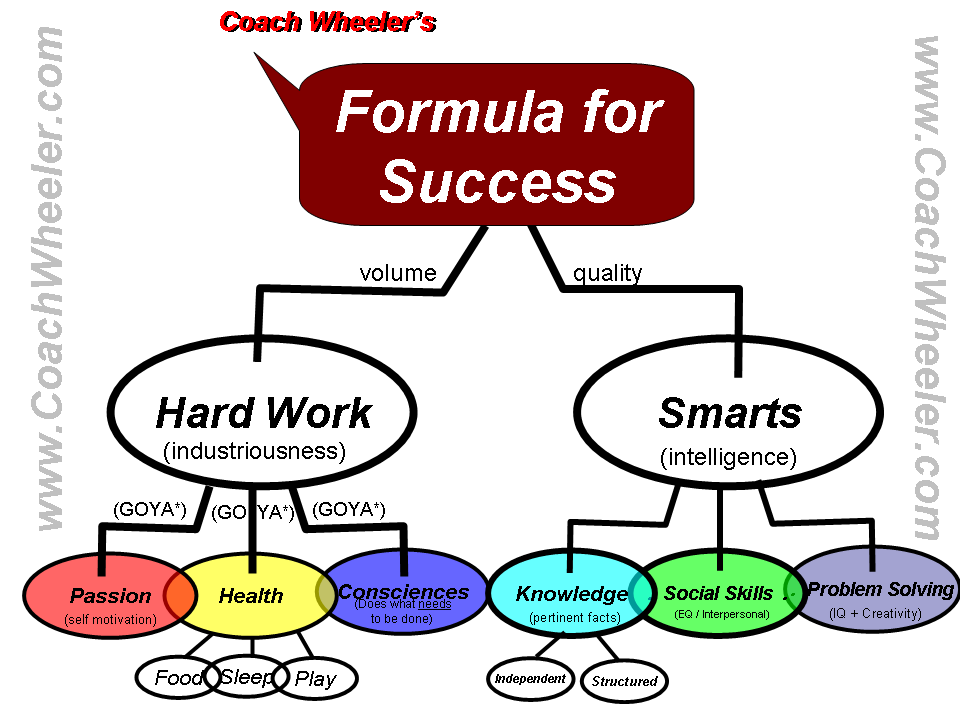
This article is a little different from the other ones on this blog. Different in a good way. The topic of Success is probably more related to your career or life in general… and less “basketball specific”. I think you will find that Coach Wheeler’s “Formula for Success” is in the vein of John Wooden’s “Pyramid of Success” that he taught his players at UCLA. If you want to “build a winning mindset”, you will definitely be interested in Coach Wheeler’s “Formula for Success”.
What kind of Formula for Success
are we talking about?
While Wheeler’s Formula for Success is primarily focused on business or career success, it can be applied in other ways. (I am hoping you will leave a comment after reading this article saying how you are going to apply the ideas in your life.) If you are looking for financial success, whether you have a job or a business, you will certainly find this “thinking framework” helpful.
Inspired by…
The top level concept, that your “volume & quality of work” determines your overall success, was inspired by Jordan B. Peterson. He is a clinical psychologist, tenured Professor at University of Toronto and, in general, a pretty smart guy from what I can tell. His knowledge of clinical psychology studies allows him to provide insights that many other “self-help” authors either miss or aren’t backing up with science. To paraphrase the success quote from him that inspired this article, “Success in life is predicted, primarily, by 2 traits: industriousness and intelligence.” (He also has a book out that is called “The 12 Rules for Life” which I have heard a lot about on podcasts so I am hoping to read it soon.)
First Layer of the Formula…
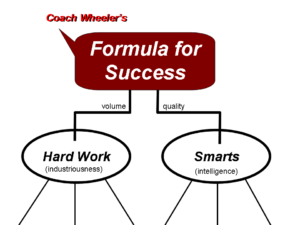
This probably won’t sound earth shattering but it should make immediate sense when you think about it. “The volume and quality of your work determines your [eventual] success in life.” Duh? Right?
If we stopped there, you probably would not get much out of this formula because that statement is common sense. But if we go deeper, you should find more ideas that you can turn into actions which will lead you to more success in your chosen field.
Next Level…
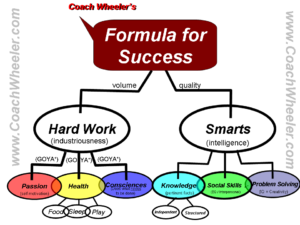
As you can see in the diagram above, I am calling the “volume” side of the formula “Hard Work”. I think we can all agree that putting in more effort and time (the definition of “hard work”?), will result in more output and productivity. If you produce more, your results should (over time) lead to success.
What goes into “Hard Work”?
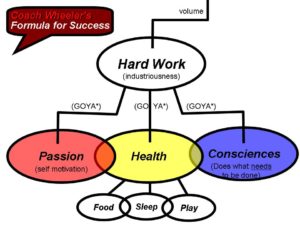
The Formula for Success has 3 parameters under “Hard Work”. They are (1) Passion, (2) Health and (3) Consciences. Let’s look at each in more depth.
(HW-1) Passion. We all need motivation if we are going to put in the hard work that is needed for success. Developing the skills of self motivation will help you do the work that others (i.e. the competition) won’t. It will also help you go further than the competition as well. The reason it is such common wisdom to say “Live Your Passion” is because it is critical to enjoy the process of “work” … so you will do more than your competitors. Think about it this way, if you are motivated by a passion for your work… is it really HARD work? Probably not. On the other hand, will you be passionate about everything you need to do? No, but we will talk about that in the third element of Hard Work, Consciences.
(HW-2) Health. This should be self-evident and common sense, but if you don’t maintain your health, you won’t be able to produce as much as possible. Letting your health decline will reduce your energy and may even “take you out of the game.” Aside from all the diet guru’s who are giving you weight management advice, Health is actually pretty simple. The three key elements of Health are a) Food, b) Sleep and c) Play.
I use the word “Play” (instead of exercise) on purpose. If you approach exercise as drudgery, you won’t enjoy it and I have heard that the effectiveness will actually decrease. Choose an exercise that you can, on some level, enjoy. It will energize your mind while building up your physical capacity at the same time.
Do we really need to discuss Diet & Sleep? 8 hours of sleep is a good goal but you can tell what works for you. If I could recommend one change to your diet, I would ask you to drink more water (instead of calorie-filled & chemical-filled drinks). We all know that green veggies are your friend… and they will impact your health & work output. Think about it like this… imagine you get a raise at work for every time you have a meal with green vegetables. [It doesn’t really work like that, but isn’t it a neat way to convince yourself to eat better?]
(HW-3) Consciences. This is related to self-discipline as well as self-identity. Are you the type of person who does what needs to be done? Especially WHEN it needs to be done? Author Jocko Willink has a good quote (and book by the same name), “Discipline = Freedom“. This is the one area that you can make the most immediate impact … if you pay attention to your thoughts and take control of your habitual ways of thinking.
I’m not talking about willpower. Willpower is a limited resource and it can “go away” when you are tired at the end of a long day or you have a dip in your motivation. Be sure to build as much of your “need to do” activities into habits and routines that you don’t have to think about. A good book for learning how to do this is “The Power of Habit” by Charles Duhigg.
One more thing about Hard Work…
Before we look at the other side of the formula (Smarts), I should explain one particular part of the Hard Work diagram. Did you notice the words “Goya”, “Goya”, “Goya” where the connector lines lead into the Hard Work bubble? This is taken from a motivational speech by inspirational keynote speaker Croix Sather. GOYA is an acronym for “Get Off Your Ass”. In terms of Coach Wheeler’s formula for success, GOYA is a reminder that you need to TAKE ACTION and not just think about what you should be doing. This is also a great transition into the “Smarts” portion of Coach Wheeler’s Formula for Success… as we keep in mind that thinking alone won’t get you what you want!
Let’s Get Smart!
The second major component of Success is “Smarts” or “general intelligence”. Coach Wheeler breaks this down into 3 parts, (1) Knowledge, (2) Social Skills and (3) Problem Solving. Going back to Jordan B. Peterson, he has said that the studies show intelligence, as measured by IQ, is incredibly difficult to improve. On the other hand, Knowledge can continually be accumulated and you can gather facts or ideas that you can use across a wide variety of situations. Coach Wheeler also added Social Skills to his model for success and we will discuss how to build and leverage them more below.
(S-1) Knowledge. As we go through life, we pick up information that we can then apply to solving problems in the future. This increases the value of our output and increases our chances for success. As you learned above, IQ is tough to change but we can “look smart” by simply learning “the tricks” for success in a given situation. There are typically two ways that we learn… independent learning and structured learning.
Independent learning is when we take the initiative and learn on our own. Examples include watching instructional YouTube video or reading books. There is an amazing amount of information out there and we probably have more access to information now than at any other time in history thanks to the internet and search engines. Smart people continue to learn.
Structured learning would include traditional schooling or perhaps one-on-one coaching. One of my favorite sayings about school is “Math = Money”. This means that learning math in school will help you handle money (and grow your wealth) when you get out into the “real world”. Depending on the quality of your teachers, it might be easy to get bored or “zone out” in school. Stay focused and keep asking yourself questions that help you stay engaged. “How will I use this in my life?” is a good one to start.
(S-2) Social Skills. There are many different types of “Smarts” and your ability to work with, and influence, other people is a major consideration when determining the quality of your work. We are not saying that you should try to make everyone happy. Sometimes you need to create conflict to get what you want or solve the problem that you are presented.
Another way to look at social skills is your ability to communicate effectively. On top of that, your leadership skills figure into your eventual success. How do you improve these things? Join Toastmasters. They are a world-wide non-profit organization dedicate to helping their members improve their public speaking and leadership skills. Find a chapter near you by visiting their website… Toastmasters International.
(S-3) Problem Solving. This is typically correlated to the people’s “inherited” qualities of IQ and creativity. Even though much of your qualities may be genetic, there is still a skill that can be developed. If you want more ideas on how to improve your Problem Solving, here is the first article in our series on the topic. To learn when we publish more Problem Solving articles, be sure to sign up for our email notification service (in the right column on this page).
It is a fair statment to say that the quality of your work output is generally tied directly to your ability to solve problems. Brain Power (i.e. IQ) is good to have, especially when you are tackling more complex problems but everyone can learn how to solve problems. If you are motivated and work hard at accumulating the knowledge you need to solve problems in your area of expertise, you will be successful. This is where I tell you that all the parts of Coach Wheeler’s Formula for Success work together to make you successful. But you probably already figured that out, right?
Bottom Line…
Will Coach Wheeler’s Formula For Success work for you? Like they say “The program will work… if you work the program.” I don’t think there is anything too “out there” in this formula. It should be easy to understand… but what are you going to do with it? Can you “up your game” when it comes to Hard Work? What do you need to improve on the “Smarts” side of the Formula for Success? If you don’t change what you do, how can you expect different results? The choice is up to you. You can use the formula… or you can “go with the flow” and take whatever life gives you. Which do you think will turn out the best for you?
Downloadable Bonus !
Congratulations! You have made it all the way to the end of this article. You deserve a reward for your efforts. (Hopefully the article was interesting and not exactly “hard work”.) Your bonus for making it this far is a downloadable copy of Coach Wheeler’s Formula for Success diagram. You are welcome to share it on social media and, ideally provide a link back to this article. Right-Click on the link below and “Save As” to get the downloadable PDF version! SuccessFormula-download-CoachWheeler
If you want to coach a varsity team or even a college team, it is inevitable that you will, at one time or another, find yourself in front of an interview committee. I have seen it become a common practice for selection committees to all sit around a conference table where they ask a prospective coach a pre-assembled list of interview questions. While there is often one or two questions that vary from school to school, there are also a number of interview questions that many schools use. Coaches who want to be hired should be prepared to answer these questions. Read them over (and the explanation that goes with each) so you are properly prepared the next time you interview for a coaching job.
(1) Describe your Strengths / Weaknesses?
This is very common for corporate jobs. It must be in an HR manual somewhere. So, how are you going to answer?Strengths should line up with the job description and be truthful. My opinion is that it is important to show the value of your strengths. This should be what separates you from the other coaches they are interviewing.
Weaknesses are a trickier subject. Presenting your “weaknesses” as a strength is probably an expected answer and, as such, is unlikely to set you apart from other candidates interviewing for the job. A better approach would be do some real soul-searching and present a real weakness… with the steps you are taking to become better.
(2) Rules are broken … what are you going to do?
It is a common scenario for an interview question. “A player violates a rule right before “the big game”. What do you do? I’ve found that it is best to “stick to the rules”… while expressing your disappointment.
Another [often unwritten] part of this question is how would you prevent the situation from happening in the first place. I try to emphasize the setting of clear expectations early in the season. This way players (and parents) know what will happen if rules are broken.
(3) Describe your typical practice plan…
I have a general format that all my practices use (and it is TOP SECRET). If you are an AD looking for a Head Basketball Coach, contact me to schedule an interview and I will “spill my guts”. In an interview, if you can’t talk about how you plan your practices, the interview committee starts to question if you are really prepared to coach their team. It also doesn’t hurt to talk about how your practices change over the course of a season. (If you want to learn how I look at different parts of a basketball season, check out this article titled “4 Part Basketball Year”.)
(4) X’s & O’s Questions…
This is usually posed by a former coach that is on the committee. They are looking to see what you know about the game and how you would approach certain game situations. It can also be a trap if your approach does not match what the former coach expects. As an up-and-coming coach, we know that a “non-traditional approach” can often be very effective, especially if it is unexpected by the competition. In an interview though,you need to convince the committee that you know what you are talking about. Examples where you used your approach successfully can help show that, while it might not match “traditional thinking”, it definitely can get the job done.
The other part of the X’s & O’s interview questions is to find out what you are bringing to the team. If your approach relies on a full stable of high quality athletes and the “pipeline is empty” for these types of athletes at this school, you may be hurting your chances of being hired. On the other hand, if you can show them how you make better players out of the ones already there, you have a chance.
(5) Why do you want this job?
Everyone has their own reason for applying. The key is that your answer needs to make sense in the context of your background. If you have been an assistant for a while, it makes sense that you want to move up to the head coaching position and run your own program. Unless you are going for a college level coaching opening, you aren’t applying to coach for the money. I have my own reasons for applying for each job… and this is something that each coach has to think about for themselves. Be as truthful as possible. This is not the time to set of the B.S detectors for the interview committee because they want to know what motivates you. (And that it matches what they want to see from their new coach.)
Bottom Line…
Be prepared for all of these standard interview questions when you apply for a coaching position. Is this a complete list of interview questions? Of course not. What this list will do is get you thinking so that you can take your preparation one step higher. If you want to be good at coaching, you need to be good at interviews. Oh yeah, one more thing…
HERE IS A BONUSFOR EVERYONE WHO HAS READ ALL THE WAY DOWN TO HERE…
Questions for the interviewers…
At the end of almost every interview I’ve ever had, I have been given the opportunity to ask my own question(s). If you don’t have any questions, you were either not paying attention to the discussion during the interview or you have not put much thought into the information you need to evaluate whether or not this job is right for you. Here are some questions to get you started. Feel free to customize them to make them “your own”.
“Who will I be working with?”
This might be obvious based on who set up the interview and who is running it (e.g. the AD & Principal) but if there are any question about it, now is the time to ask. Another aspect of this is how they expect the communication process to be handled with parents of players. For a new coach who the parents are not comfortable approaching, they may take their complaints directly to the AD, Principal or even the school’s superintendent. As a coach, you want to head this off and address concerns before they become major issues.
“What are the key things that need to change [from the previous coach]?” “What are their expectations for the new coach?”
The previous coach left for a reason. Was their job not re-offered? Or did they see the writing on the wall (few quality players in the pipeline) and figured it was a good time to “retire”. As the new incoming coach, you might not get the full story (or they may decline to talk about it due to confidentiality reasons) but if you phrase it discreetly you may get some insights into what they want to see from their new coach. This gives you a chance to shine a light on how you are the best choice for the position.
“Since I, as the new coach, plan to raise the standards both on the court and off, how will this be supported by the school and parents?”
Some schools are happy just fielding a team and winning is not a priority. Maybe they are a “baseball school” or a “soccer school” and a winning basketball program is not a top priority. It is important that you, as the new coach, understand what support you will receive. It is likely that higher standards will not be appreciated, especially by the parents of players who do not meet those standards. Again, it is important to communicate with parents so they understand what you are trying to accomplish.
Are you looking for a coach that will build a competitive team? Or would you prefer someone who “keeps everyone [sort of] happy”?
This is another form of the question above. It will help you gauge where the school sees it’s basketball program. In my experience, the idea of “keeping everyone happy” is a fool’s errand and unlikely to happen. Another way to look at it is this… players earn their playing time based on what the coaches see in practice. If they want more time, they should talk to their coaches and put in more effort.
Fundraising is an important part of many athletic programs. Can you describe what is done at your school in terms of fundraising for the basketball program?
The amount budgeted for the team compared to what will need to be picked up by parents or outside sponsors is also good to know. If you can bring some fundraising ideas or, better yet, can involve parents in the process, you will be one step ahead of some candidates.
The end of the interview…
Always try to leave on a high note. SMILE. Sometimes something as simple as a smile and a good handshake is enough. The last question and the last thing you say is what will stick in the memory of the interview committee. (Assuming you did not mess up big time in the rest of the interview.) Stay positive and, as much as possible, leave on an up-note… and they followup after an appropriate amount of time.
Will this list of interview questions guarantee success?
I hope these interview questions will help make you more successful. Of course, they won’t magically move you to the top of the list if the committee has already made up their mind. In that case, the interviews are often just a formality so the committee can check off a box that says they held interviews. What does that mean for you as the “odd man out”? It means you got a chance to practice your interviewing skills and will do even better at the next interview. In basketball you don’t expect your players to hit 100% of their shots. Interviewing is a percentage game too. Hang in there and keep working to make your resume more attractive to potential employers. Do your preparation for every interview … and eventually the numbers will be in your favor! Good luck… unless I am interviewing for the same job. In that case, disregard everything in this article. 😉
The one basketball season ends and another basketball year begins. If you are only playing and working on your game during the “official school season” than you are missing out. Below are the 4 sections / timelines that make up the “4 part basketball year” plus the off-season. Let’s start with the day after your school season ends…
Off Season (Spring/Summer/Fall)
Spring AAU
Summer League
Fall AAU
Open gym(s) at school
Pickup games
Weight Training
Once practices can start, the season is officially ON ! Below are the parts of the season along with the focus area for each time period.
1st Quarter- Pre-Season – before first game
Tryouts
Practices / Conditioning
Learn techniques and formations
Scrimmages
Keep it simple / Learn The Basics
2nd Quarter – First Encounters (1st Half of Season)
Play first round of home/away games
Find out what works vs. competition (adapt as needed)
Fine tune & Accelerate “The Basics”
Continue conditioning / strength gains
Gauge the competition (Strengths & Weaknesses)
3rd Quarter – Revenge/Payback time (2nd Half of Season)
Must get better (the competition isn’t standing still)
Prep for playoffs
Keep conditioning / Make it Fun !
Maintain FOCUS. Stay sharp.
Take breaks when needed to maintain energy.
Cold & Flu season… rest to recover quicker.
4th Quarter – Win or Go Home (Playoffs)
Perform at your best.
Few “Easy Wins”… even lower seeds are playing hard.
Have a few surprises up your sleeve.
High level of Mental Toughness / Facing The Challenges
Why use “4 Part Basketball Year”?
Breaking up the season into “chucks”, each with a different area of focus and specific “feel”, helps your team fight the boredom of a long season. It also breaks up the grind of weeks of conditioning and keeps players fresh.
A physical test in each quarter, either as part of a game or practice, can be a good milestone to show progress when compared with tests earlier in the season. I like to have some standard tests for evaluating players and it is good to come back to them in each section of the season to show players that they are indeed getting better.
Bottom line…
Looking at the overall season as a “4 part basketball year” helps your planning efforts as a coach. It should also make the year more enjoyable and more successful for your players. The outline above is just a starting point. Feel free to add your own components to each section and use the outline as a planning tool for this year as well as years to come. If you see something that doesn’t belong, please leave us a comment below. Even if you disagree, your comments and ideas will be helping us get better.
What does it mean for a player to “take their game to the next level”? It sounds like a good thing but without understanding the meaning it is hard to get there, right?
Plus… even if you have an idea of what the “next level” is for your basketball game, the question of “How do I take my game to the next level?” is still critically important.
This article will answer those questions (from Coach Wheeler’s perspective) and provide you with an example of a player who might Coach Wheeler could help “take their game to the next level.”
What are “the Levels”?
Below are the various levels from middle school through high school and even into college. If you are interested in seeing some of the skills that are typically developed at each level, check out Coach Wheeler’s article on a Player Progression Plan.
Middle School
High School – Player / non-starter… Losing team
High School – Player / starter… Losing team
High School – Player / non-starter… Winning team
High School – Player / starter… Winning team
High School – Player / starter… college-level skills (D3/Community College)
High School – Player / starter… All-state-Honorable mention
High School – Player / starter… All-state-2nd Team
High School – Player / starter… All-state-1st Team
College Starter – D3 / Community College
College Player * – D2
College Player * – D1
* There are obviously many levels within “college”. Most players won’t need to worry about this since even “best in state” does not mean that you are guaranteed a scholarship at the college level.
There could be even more levels if you include various AAU team or individual milestones (tourney wins, elite team participation, etc.). Again, this is a simple framework for players that are working on their game, probably at some level in high school, and looking to go “to the next level”.
Beyond skill development, WINNING is another way to move up a level or two. Players on teams that win get more attention from people who evaluate players.
Since basketball is a team game, if you want to win more games, you need to look at your role on the team. What does the team need to win more games? How well are you performing your role on the team? How can you do more? Or better?
You might have some ideas for these questions but don’t settle for your own answers. ASK others to get a better idea of what will take your game to the next level. ASK Coaches… your current coach (obviously), past coaches who have seen you play recently, AAU coaches, assistant coaches and even players whose basketball knowledge you respect.
When you ASK, you could say something like, “I want to take my game to the next level, what do you think I need to improve?” Be open to the answers but look for common answers that come up often. Also, don’t get upset if someone identifies a weakness that you are not proud of. Many people will only give you “good news” and it is important to value people who will “tell it like it is”. You don’t want sugar-coated feedback. You want the truth… and you need to act on the truth!
Coach Wheeler’s “Next Level real Player Example”:
I coached this player as part of an AAU team when he was a freshman and he was a pretty good shooter. I won’t “name names” since I don’t want to embarrass him. Plus the advice could apply to a number of players.
As a sophomore, our “example player” saw some good minutes on his varsity team but he played a secondary role to seniors who played a similar position.
When I saw him a year later in a summer league, he had improved his ability to drive and make shots. The team he played on did not have great players so he probably had to carry a bigger scoring load than he might on another team.
Next Level tip:
This player has pretty good court vision since he handles the ball most of the time and rarely dribbles into traps or places he might lose the ball. His court awareness is part of how he might take his game (and the success of his team) to the next level.
He should work with his team so that they move into scoring position as he drives. For example, wing shooters need to get open to potentially receive a kick-out pass. Big men need to recognize when he is going to drive and find a lane where they can be open if the opposition collapses on the driver. Even if the driver shoots, big men should be actively getting in position for the rebound.
How are all these things the responsibility of the player with the ball? First, basketball is a team game and even if you are the best player in the world the other players on the court need to be active. Michael Jordan did not win a single NBA championship before Coach Phil Jackson brought in the triangle offense and convinced MJ that involving others was in his best interest (especially if he wanted to win).
Second, if you are the primary ball handler (as this player is in our example) your key responsibility is to distribute the ball for the highest percentage shot possible. That means “getting the other players to move to the right places”. Sometimes the coach sets up plays for the team but more often players have to work together on the court in various situations.
This is just Coach Wheeler’s idea for how this player could get to “the next level”. As we mentioned earlier, he should be getting feedback from all the coaches in his life… and taking action.
Bottom line…
If you want to get better, you will have to take action. Basketball is highly competitive. You are not just competing within your school’s division. You are competing against everyone near your age who is playing basketball and trying to get to the next level. Remember, after your senior year in high school, no matter how good you are, the next year you are a freshman in college. From the big fish in the small pond to a small fish in THE OCEAN! The time to move to the Next Level is NOW. Don’t wait. Your future depends on it!







 This probably won’t sound earth shattering but it should make immediate sense when you think about it. “The
  The Formula for Success has 3 parameters under “Hard Work”. They are (1) Passion, (2) Health and (3) Consciences. Let’s look at each in more depth.
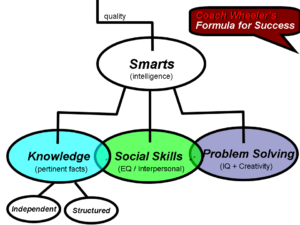 The second major component of Success is “Smarts” or “general intelligence”. Coach Wheeler breaks this down into 3 parts, (1) Knowledge, (2) Social Skills and (3) Problem Solving. Going back to Jordan B. Peterson, he has said that the studies show intelligence, as measured by IQ, is incredibly difficult to improve. On the other hand, Knowledge can continually be accumulated and you can gather facts or ideas that you can use across a wide variety of situations. Coach Wheeler also added Social Skills to his model for success and we will discuss how to build and leverage them more below.
 If you want to coach a varsity team or even a college team, it is inevitable that you will, at one time or another, find yourself in front of an
  The one basketball season ends and another basketball year begins. If you are only playing and working on your game during the “official school season” than you are missing out. Below are the 4 sections / timelines that make up the “4 part basketball year” plus the off-season. Let’s start with the day after your school season ends…
 What does it mean for a player to “take their game to the next level”? It sounds like a good thing but without understanding the meaning it is hard to get there, right?
 I coached this player as part of an AAU team when he was a freshman and he was a pretty good shooter. I won’t “name names” since I don’t want to embarrass him. Plus the advice could apply to a number of players.