
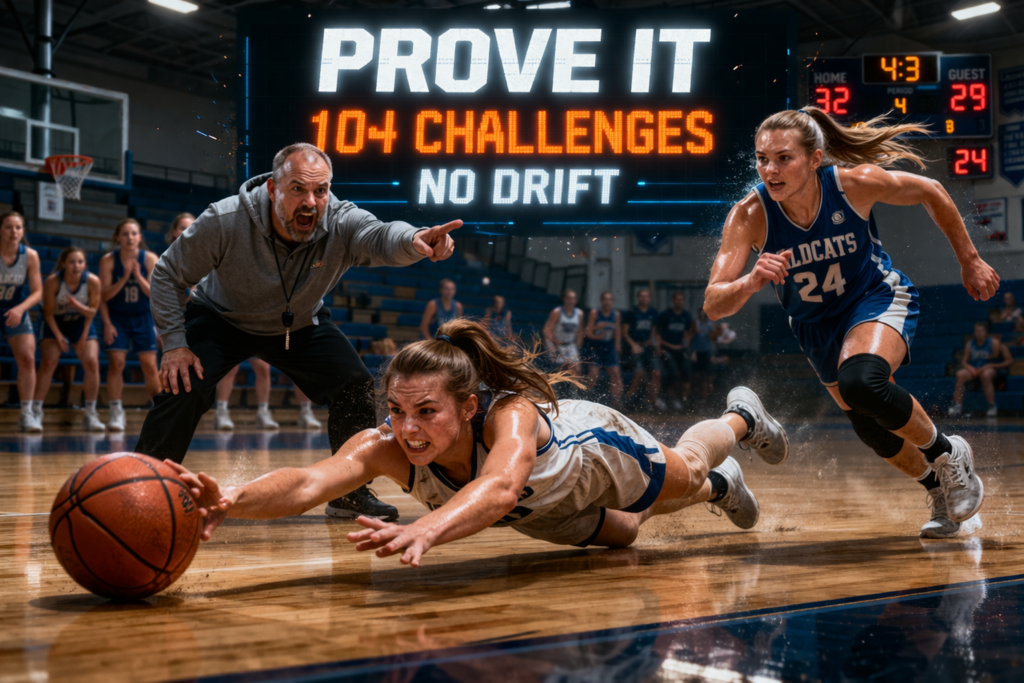
Stop running drills. Start demanding proof. Walk into most gyms and you’ll see good work. Lines are tight. Drills are organized. Coaches are talking. And then the game hits… and it disappears. I’ve lived that. So I made a shift—not in plays, not in schemes… In how we train. It is called “basketball practice challenges”
XPLAIN: What This Really Is
A drill tells players what to do. A challenge asks:
“Can you prove it… right now… when it matters?”
That’s the difference.
- Drills create activity
- Challenges create accountability
- Drills build comfort
- Challenges build capacity
- Drills look good
- Challenges translate
If it’s not tested, measured, and proven…
It’s just talk.
What Happens When You Flip the Switch
The moment you introduce real challenges, your gym changes.
Effort becomes visible
No guessing. It’s timed. It’s scored.
Focus sharpens
Standards replace speeches.
Accountability shows up
The board tells the truth.
Confidence gets earned
Not hype—proof under pressure.
XAMPLE: Same Drill. Different Team.
Full-court sprints.
Old way: “Run 10.”
Challenge way: “10 sprints. Every rep under 6 seconds. Miss one—we restart.”
Now:
- Teammates hold each other accountable
- Standards get protected
- Nobody hides
Same drill. Different identity.
Why You Need This
Games don’t care what you practiced. They ask:
- Can you execute when tired?
- Can you think when it’s chaotic?
- Can you respond after a mistake?
- Can you win when it’s uncomfortable?
If your practices don’t ask those questions… The game will.
🔄 XCHANGE: How We Build It Through the Season
This isn’t random. It’s layered.
Early Season — Build the Engine
Physical Challenges
We go heavy here:
- Timed sprint standards
- Rebounding battles
- Shooting volume competitions
Example:
“1-minute layup challenge—team must hit 25 or we reset.”
You’re building capacity.
Mid-Season — Lock the Mind
Mental Challenges
Now we stress focus:
- Pressure free throws (with consequences)
- Silent scrimmages
- “Next play” response challenges
Example:
“Miss 2 free throws as a team—everyone runs.”
You’re building discipline.
Late Season — Win the Moment
Game Situation Challenges
Now it’s real:
- Down 3, 30 seconds
- Up 2, need a stop
- BLOB/SLOB execution
Example:
“You’re down 2. 18 seconds. No timeout. Solve it.”
You’re building execution.
All Season — Control What Matters
Control Challenges
Daily identity work:
- Sprint to huddle
- No negative body language
- Talk every possession
Example:
“Zero hands on hips all practice—or we redo the last drill.”
You’re building culture.
⚙️ How I Run It
Simple. Every practice:
At least one challenge… Physical, Mental and Game or Control
usually less than 10–15 minutes.
Track it. Post it. Name winners.
Get the Full System (104 Challenges)
What you just read is the philosophy.
But philosophy without structure… fades.
That’s why I built:
The Coach Wheeler Challenge Philosophy eBook: with 104 Challenges
Inside, you get:
All 4 Categories Fully Built Out:
- 26 Physical Challenges (timed, competitive, measurable)
- 26 Mental Challenges (focus, discipline, response)
- 26 Game Situation Challenges (real-game execution)
- 26 Control Challenges (effort, energy, culture)
Real Examples You Can Run Tomorrow:
- “Win the Drill Twice” (consistency pressure)
- “3 Stops in a Row” (defensive identity)
- “Clutch Free Throw Ladder” (pressure shooting)
- “No Walk Practice” (effort standard)
- “Down 3, 30 Seconds” (game reality)
Each one is designed to:
- Be simple to implement
- Create immediate buy-in
- Produce visible results
Final Thought
You don’t need more drills. You need more proof.
Because at some point, your team will face a moment where:
- It’s tight
- It’s loud
- It’s uncomfortable
And they won’t rise to what you said. They’ll fall back on what they’ve proven.
“Did we prove it today?”
If you want that answer to be yes…
👉 Grab the Challenge Philosophy eBook including 104 Challenges for Highly Competitive Basketball Teams (the link will be added here when it is released or you can simply sign up for Coach Wheeler’s email list) and start building a team that doesn’t hope to win— They expect to.
And here’s where it gets even better…
These 104 challenges are also being turned into two card decks:
- One for Physical + Game challenges
- One for Mental + Control challenges
So you can literally pull a challenge and run it on the spot.
Plus:
- Practice integration system
- Tracking ideas
- Seasonal progression plan
 I have started to think about how I might help MOTIVATED basketball players with their summer development plan. In an ideal world, I would gather a group of 8-10 players who would meet at an outside court every morning at sunrise (5am? 6am?) to get a thousand shots up and work on their conditioning, moves and defensive skills.
 The one basketball season ends and another basketball year begins. If you are only playing and working on your game during the “official school season” than you are missing out. Below are the 4 sections / timelines that make up the “4 part basketball year” plus the off-season. Let’s start with the day after your school season ends…