
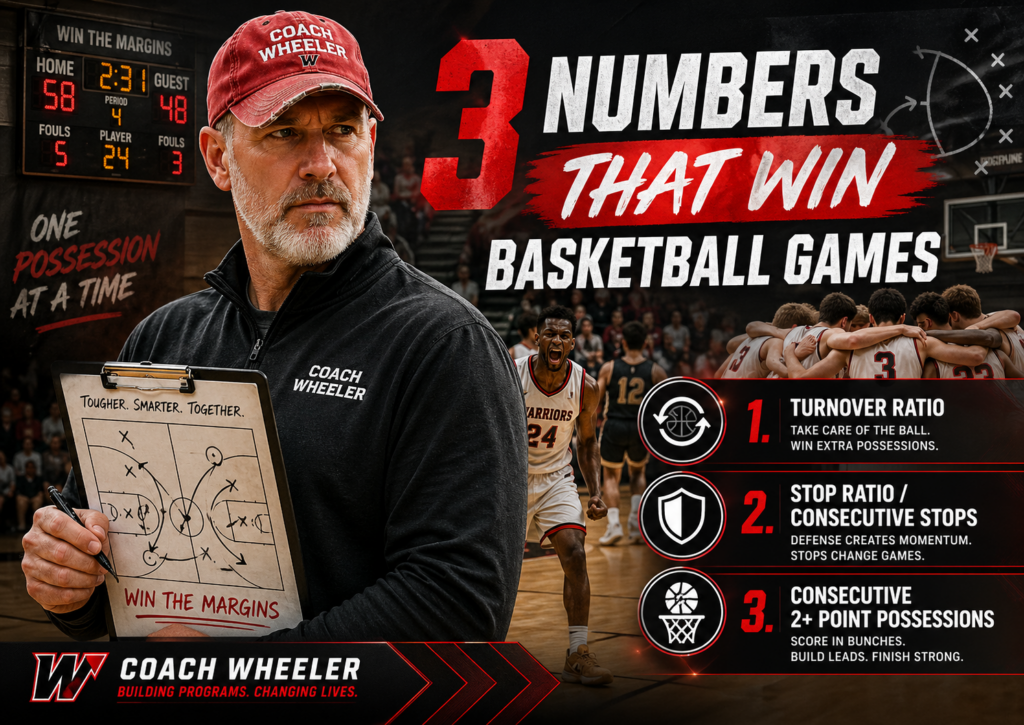
Every basketball coach says they want to win. But not every coach tracks the things that actually lead to winning.
That’s where games are often decided — not in the final score, but in the smaller scoreboards running underneath the game.
A football coach might talk about turnover ratio, missed tackles, and explosive plays. Simple. Clear. Connected directly to winning.
So what are the basketball equivalents?
Not complicated analytics that require a full-time video coordinator. Not a spreadsheet with 47 categories nobody looks at after the game. I’m talking about simple basketball stats to track that a high school coach, assistant coach, team manager, or parent volunteer can chart from the bench.
Here are the three numbers that can change a basketball program:
- Turnover Ratio
- Consecutive Stops and Stop Ratio
- Consecutive Possessions with 2 or More Points Scored
These three stats don’t just describe what happened.
They teach your team how to win.
1. Turnover Ratio: Who Won the Possession Battle?
Basketball is a possession game.
Every possession has value. Every careless turnover is a gift. Every forced turnover is an opportunity. That’s why turnover ratio is one of the most important basketball stats to track.
The idea is simple:
Turnover Ratio = Turnovers Forced vs. Turnovers Committed
If we force 18 turnovers and commit 11, we are plus+7.
That means we likely created seven extra opportunities to score. That might be seven extra fast breaks, seven extra chances to get fouled, or seven extra possessions where the other team never even got a shot.
Turnovers matter because they often lead to high-percentage scoring chances for the opponent, especially in transition. Breakthrough Basketball notes that turnovers can create fast-break opportunities and can even contribute to foul trouble.
But this stat is not just about yelling, “Take care of the ball!” That doesn’t coach anybody.
Turnover ratio forces better questions:
Are we making the simple pass?
Are we spacing the floor?
Are we meeting passes?
Are we attacking under control?
Are we creating turnovers with pressure, traps, anticipation, and hustle?
A turnover is rarely just one player’s mistake. Sometimes the passer is late. Sometimes the receiver drifts. Sometimes teammates stand still. Sometimes the player with the ball has no good option because the other four players are watching instead of moving.
That is why turnover ratio is a team stat.
It teaches shared responsibility.
Win the turnover battle, and you give yourself a chance to win the game.
Lose it badly, and you may spend the whole night trying to recover from mistakes you gave away for free.
2. Consecutive Stops and the Stop Ratio:
Can We Break Their Rhythm?
Most teams talk about defense. Winning teams measure it.
A stop means the opponent had a possession and did not score.
That’s it.
They miss and we rebound? Stop.
They turn it over? Stop.
They take a bad shot and we secure the ball? Stop.
They miss, get the offensive rebound, and score? Not a stop.
They miss, get fouled on the rebound, and score at the line? Not a stop.
Defense is not finished when the shot goes up. Defense is finished when we have the ball.
That one sentence can change a team.
There are two defensive numbers I want to track.
The first is consecutive stops.
How many defensive stops can we stack in a row?
Can we get three straight stops?
Can we get four?
Can we get five?
Three stops in a row gives your offense a chance to create separation. Four or five stops in a row can change the emotion of the entire gym.
That’s when the other coach starts pacing.
That’s when the other team starts rushing.
That’s when their best player starts forcing.
That’s when our bench comes alive.
The second number is Stop Ratio.
Stop Ratio = Our Defensive Stops vs. Their Defensive Stops
If we stop them 30 times and they stop us 24 times, we won the stop battle.
That matters.
A team can survive a cold shooting night if it gets enough stops. A team can survive a rough offensive stretch if it refuses to let the other team run away. Defensive statistics like opponent shooting percentage, possessions, turnovers, steals, and rebounding are commonly recommended for understanding defensive performance.
Stop Ratio gives your players a clear mission:
Get the ball back without giving up points.
Not “play harder.”
Not “want it more.”
Get a stop.
Then get another one.
Then another.
This is how defense becomes visible. Players start to understand that a deflection matters. A box out matters. A strong closeout matters. A trap that forces a panic pass matters. A rotation that prevents a layup matters.
The scoreboard only shows points.
Stop Ratio shows the work that prevents them.
3. Consecutive Possessions with 2 or More Points Scored: Can We Build a Run?
Basketball games are often decided by runs.
A 6-0 run.
An 8-2 run.
A 10-0 run that turns a close game into panic.
But runs do not happen by accident.
They happen when one team stacks winning possessions.
That is why the third stat is:
Consecutive possessions with 2 or more points scored.
This is different from just tracking field goal percentage.
A possession with 2 or more points could be:
A layup.
A putback.
Two made free throws.
A three-pointer.
An and-one.
A great offensive possession that ends with a high-value shot.
The point is not just, “Did we shoot well?”
The point is:
Can we score on consecutive possessions and put pressure on the other team?
One made basket is nice.
Three scoring possessions in a row changes the game.
Four can force a timeout.
Five can break belief.
This stat teaches players how to think about offensive efficiency without burying them in advanced terminology. Modern basketball analysis often looks at offensive and defensive efficiency through points per possession or points per 100 possessions, but high school teams can begin with simpler possession-based tracking.
For high school players, “score 2 or more points on this possession” is concrete.
It teaches shot selection.
It teaches attacking the paint.
It teaches getting to the free-throw line.
It teaches offensive rebounding.
It teaches passing up a decent shot to create a better one.
And it teaches the team that offense is not about one player hunting points.
It is about the group creating pressure.
A rushed shot early in the possession may technically be open, but does it help us stack scoring possessions?
A wild drive into three defenders might feel aggressive, but does it produce 2 or more points?
A lazy pass around the perimeter might look like offense, but did we ever make the defense uncomfortable?
Winning offense creates problems.
It forces rotations.
It attacks gaps.
It gets paint touches.
It turns good shots into great shots.
It crashes the glass.
It scores, then gets ready to defend.
The Real Magic:
Stack Stops and Scores Together
The power of these three basketball stats is not that they stand alone.
The power is how they connect.
Force a turnover.
Score 2 or more.
Get a stop.
Score 2 or more.
Get another stop.
Score again.
That is how a game flips.
Not with a miracle.
Not with a speech.
Not with one player trying to save the team.
Games flip when a team stacks winning possessions.
That is the game inside the game.
And once players understand that, they start seeing basketball differently.
They stop thinking only about the final score and start thinking about the next possession.
Can we force a turnover?
Can we get a stop?
Can we score 2 or more?
Can we do it again?
That is winning basketball.
How These Stats Can Help Turn Around a Program
A struggling basketball program does not always need a brand-new identity, a complicated offense, or a miracle group of athletes walking through the door.
Sometimes it needs a simpler scoreboard.
A losing program often has vague problems:
“We need to be tougher.”
“We need to play smarter.”
“We need to compete.”
“We need to stop making mistakes.”
“We need to finish games.”
Those statements may be true, but they are not specific enough to fix.
These three stats make the problem visible.
If the team is losing the turnover battle, start there.
If the team cannot get three stops in a row, start there.
If the team cannot put together three scoring possessions in a row, start there.
Now practice has purpose.
Film has purpose.
Players have targets.
Assistant coaches have language.
Parents can understand what the team is trying to build.
And the program starts shifting from “hoping to win” to training the behaviors that produce winning.
That matters.
Especially in a program that has been losing.
Because belief does not come from pretending everything is fine.
Belief comes from proof.
When players see that they forced 20 turnovers, got four stops in a row twice, and stacked three scoring possessions in the third quarter, they can feel progress.
Even before the record fully changes, the identity starts changing.
That is how turnarounds begin.
One measurable behavior at a time.
How to Track These Basketball Stats During a Game
You do not need a complicated system.
Use a clipboard.
Create three sections.
Turnover Ratio
Track:
Our turnovers
Their turnovers
Plus/minus difference
Goal: win the turnover battle.
Consecutive Stops / Stop Ratio
For each opponent possession, mark:
S = Stop
P = Points allowed
Circle every streak of three or more stops.
At the end of the game, compare our stops to their stops.
Goal: win the Stop Ratio and create multiple stop streaks.
Consecutive Possessions with 2+ Points
For each offensive possession, mark whether we scored 2 or more points.
Circle streaks of three or more.
Goal: create scoring runs by stacking productive possessions.
This is simple enough for a manager, assistant coach, or injured player to track.
More importantly, it is simple enough for players to understand.
How to Build These Stats Into Practice
Do not just track these numbers in games.
Train them.
Run a defensive drill where the team must get three stops in a row before switching.
Run a scrimmage where turnovers are minus-two points.
Run a scoring challenge where the offense must score 2 or more points on three straight possessions.
Run a “Win the Ratio” segment where the only thing that matters is stops compared to scores.
Put the numbers on the board.
Talk about them before games.
Review them after games.
Celebrate the players who create them.
Because players repeat what gets recognized.
If we only celebrate points, players chase points.
If we celebrate stops, deflections, smart passes, strong catches, rebounds, paint touches, and winning possessions, players start chasing winning.
That is the shift.
The Bottom Line

Let’s be real… The final scoreboard matters.
But the final scoreboard is usually the result of smaller scoreboards running all game long. The turnover scoreboard. The stop scoreboard. The scoring-streak scoreboard.
Win those, and you give yourself a real chance to win the game.
These are not just stats.
They are teaching tools.
They are culture tools.
They are turnaround tools.
They help players understand what winning actually requires.
- Take care of the ball.
- Get the ball back.
- Score with purpose.
- Do it again.
That is not complicated.
But it is powerful.
Winning is not magic.
Winning is measured.
Winning is trained.
Winning is built one possession at a time.
Let’s Roll.
Ready to start developing the habits that actually lead to winning? Download the free Winning Mindset Playbook and start building the confidence, discipline, toughness, and daily standards that turn effort into results.
Whether you’re a player, coach, parent, or leader, this playbook gives you a practical starting point for training the mindset behind better decisions, stronger habits, and bigger wins — one possession, one practice, one step at a time.