
Basketball has a strange habit. Something happens—and players stop.
A shot goes through the basket. Someone celebrates.
A whistle doesn’t come. Someone complains.
A rebound is secured. Someone watches.
A turnover happens. Someone hangs his head.
For a second or two, basketball players routinely behave as though one part of the game has ended and another is about to begin. Except basketball never stopped.
The clock may still be moving. The ball is live. The floor is changing. The defense is organizing. An advantage may exist for only a fraction of a second.
For generations, some of basketball’s most innovative coaches have recognized the same fundamental opportunity:
Act before the other team is ready.
They called it different things. They built different systems around it. Some emphasized transition offense. Some pushed tempo to almost absurd extremes. Some pressed relentlessly. Others stretched the court with shooting and spacing.
But the historical record keeps returning to the same idea.
Fast basketball can win.
Not because running is magical.
Because basketball rewards the team that can create an advantage before its opponent can organize to stop it.
Red Auerbach:
Don’t Let the Defense Get Set
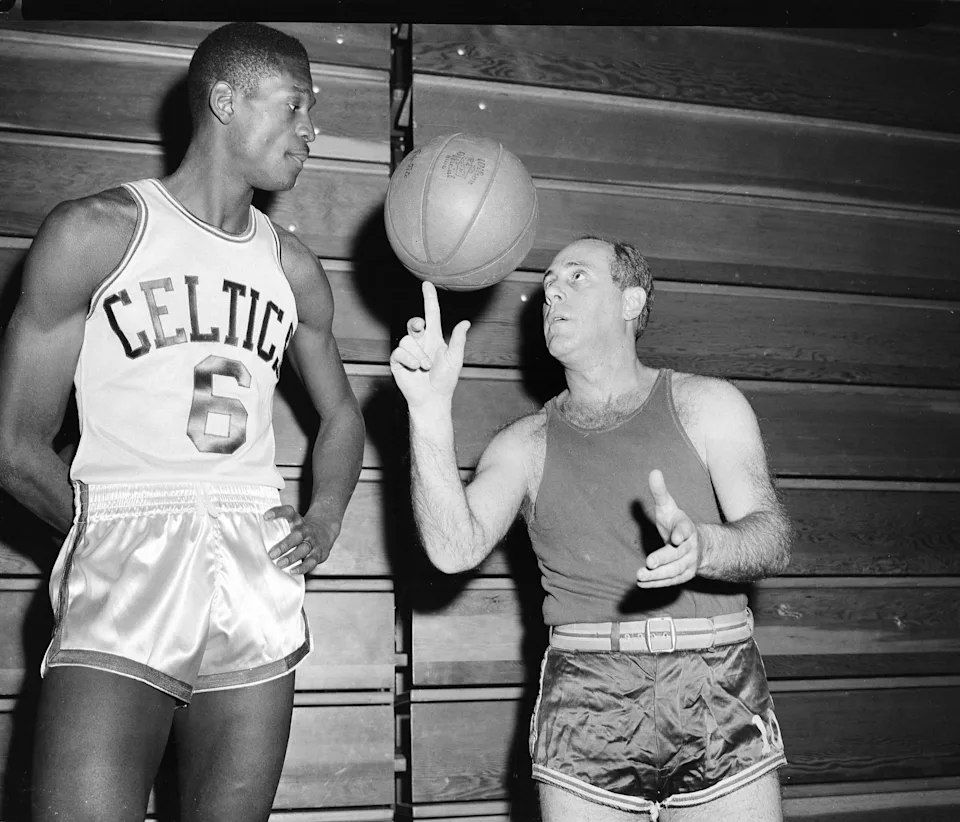
Long before “pace and space” became basketball vocabulary, Red Auerbach was building Boston Celtics teams designed to run.
Then Bill Russell arrived.
The Celtics already had offensive talent in Bob Cousy, Bill Sharman and others, but they had lacked the defense and rebounding necessary to become champions. Russell changed both—and created something else.
A defensive stop could become offense almost instantly.
Russell would rebound the ball and fire an outlet pass. Cousy and the Celtics would attack before the opponent could organize its defense. NBA.com’s history of Russell specifically identifies his rebounding and outlet passing as the ignition for Boston’s famous fast break.
That seems obvious today.
It wasn’t always.
A rebound did not have to represent the end of defense followed by the beginning of offense.
It could be one continuous action.
Rebound. Outlet. Run. Attack.
And the results are difficult to dismiss.
With Russell anchoring the team, Boston began a dynasty that produced 11 championships in 13 seasons. Auerbach coached the first nine of them—including eight consecutive championships and nine titles in his final ten seasons on the Celtics bench.
Fastbreak basketball didn’t do that by itself.
Russell mattered. Cousy mattered. Defense mattered. Talent mattered. Coaching mattered.
But Auerbach had recognized an enduring truth:
The easiest defense to attack may be the defense that hasn’t become a defense yet.
That idea never went away.
It just became more extreme.
Paul Westhead:
What If We Make Them Play Fast Too?
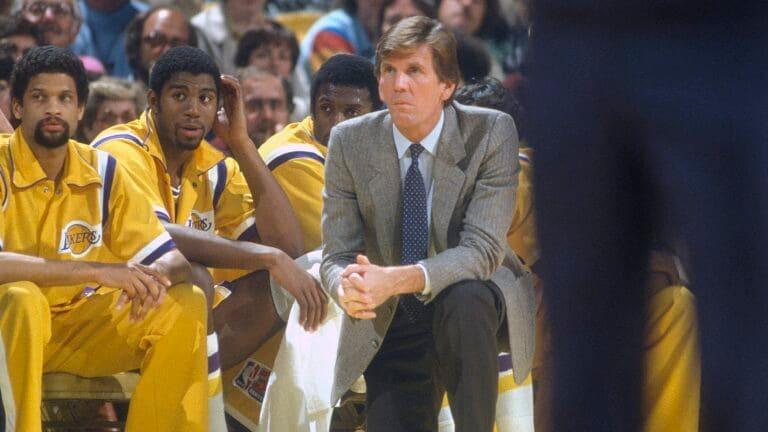
Paul Westhead took basketball’s fascination with speed into very different territory.
His Loyola Marymount teams of the late 1980s and early 1990s didn’t merely run.
They tried to make the entire game run.
The philosophy became known simply as The System.
Get the ball up the floor.
Attack quickly.
Take open shots.
Press.
Substitute.
Run again.
The interesting innovation wasn’t merely that Westhead wanted his own team playing fast.
He discovered that his defense could make the opponent play fast too.
Teams naturally tried to slow Loyola Marymount down. So Westhead applied full-court pressure. That pressure created an unusual dilemma: opponents could either risk turnovers against the press or exploit it quickly.
Either way, possessions accelerated.
The opponent was now participating in Loyola’s preferred game.
That is an important evolution of fastbreak thinking.
Auerbach essentially said:
When we get the ball, run.
Westhead pushed toward:
We’re going to make this whole game run.
The numbers became outrageous.
Over three consecutive seasons, Loyola Marymount led the nation in scoring. The 1989–90 team averaged an NCAA-record 122.4 points per game and advanced to the Elite Eight.
Think about 122 points per game in college basketball.
Not occasionally.
On average.
Westhead demonstrated that pace wasn’t merely an offensive tactic.
It could become an environmental condition.
You could force another team to solve basketball problems at a speed it did not choose.
That concept would reappear in a somewhat different—and ultimately championship-winning—form.
Nolan Richardson:
Forty Minutes of Hell
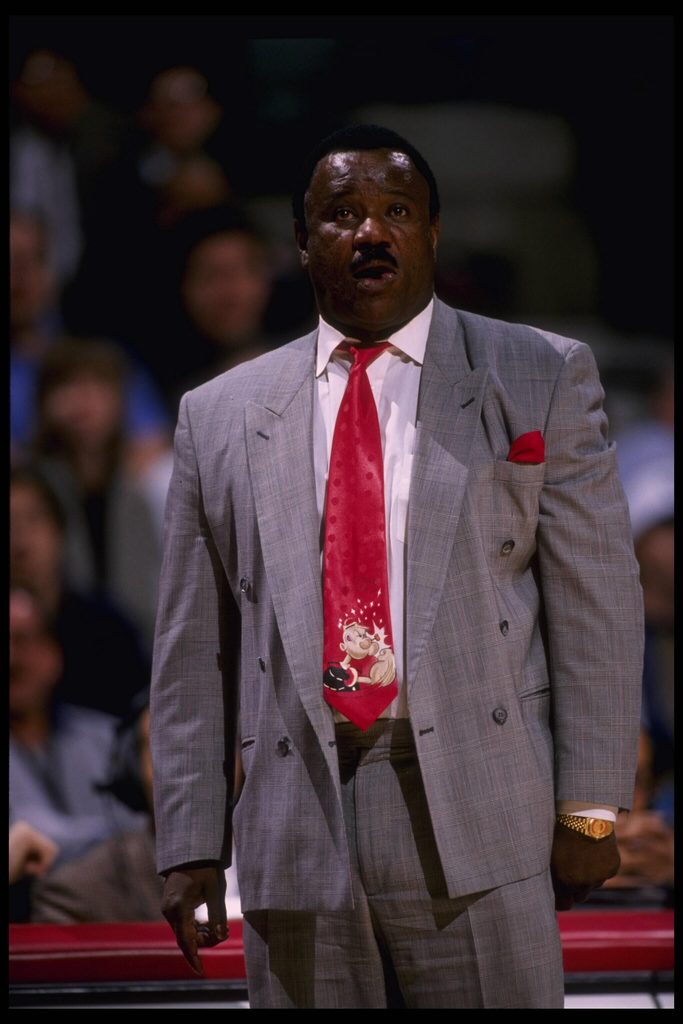
Nolan Richardson didn’t merely want his Arkansas teams to play fast.
He wanted opponents to feel pressure continuously.
Richardson’s famous system became known as 40 Minutes of Hell, but the nickname can make the philosophy sound simpler than it really was.
It wasn’t just a full-court press.
Richardson described it as both an offensive and defensive mentality. Full court, three-quarter court or half court wasn’t the defining characteristic.
Attack was.
His teams wanted to push the ball offensively, pressure it defensively, attack the boards, create deflections and deny opponents the comfort of simply running their preferred game.
And Richardson trained that identity.
Arkansas players remembered practices containing long stretches of essentially continuous basketball—score, turn around, pick up full court, play through contact, attack again. Richardson wanted practice to become harder than games.
The approach worked long before Arkansas.
Richardson won a junior-college national championship at Western Texas, an NIT championship at Tulsa and eventually the 1994 NCAA championship at Arkansas. His Arkansas teams reached three Final Fours, and he remains the only coach to win NJCAA, NIT and NCAA Division I championships.
Richardson had taken another step in the evolution.
Auerbach attacked before defenses could organize.
Westhead manipulated the game’s tempo.
Richardson turned pressure into an identity.
His team wasn’t waiting for a particular situation to start playing aggressively.
Aggression was the default state.
Offense attacked.
Defense attacked.
Rebounding attacked.
Practice reinforced it.
And opponents had to survive it for forty minutes.
But basketball’s next great fastbreak development would come from a coach who discovered that speed wasn’t only about running faster.
Mike D’Antoni:
Space Can Make Basketball Faster
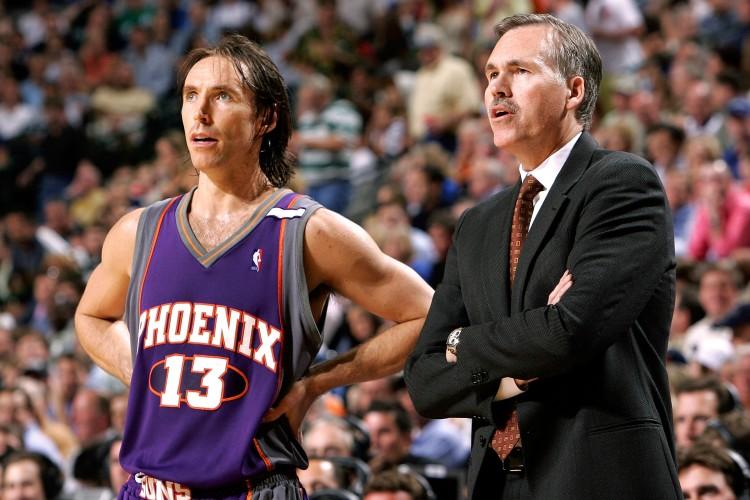
Mike D’Antoni’s Phoenix Suns produced one of basketball’s most dramatic turnarounds.
Phoenix won 29 games in 2003–04.
In D’Antoni’s first full season as head coach, with Steve Nash back in Phoenix, the Suns won 62.
They started 31–4 and jumped from 21st in offensive efficiency to first.
The offense became immortalized by the phrase:
Seven Seconds or Less.
Run.
Spread the floor.
Let Nash attack before the defense establishes itself.
Put Amar’e Stoudemire in open space.
Surround the action with shooters.
Force defenders into impossible decisions.
But history has somewhat misunderstood what D’Antoni proved.
The lesson wasn’t simply:
Shoot faster.
The deeper innovation was space.
D’Antoni used smaller lineups, shooting, pick-and-rolls and freedom of movement to create decisions the defense had to make quickly. NBA analysis of his career notes that the “space” half of pace-and-space may have been more revolutionary than the actual pace. His later 65-win Houston Rockets led the NBA in offensive efficiency despite ranking only 13th in pace.
That’s important.
A team can attack quickly without necessarily taking an immediate shot.
The real question isn’t:
How fast can we shoot?
It’s:
How quickly can we create an advantage?
Phoenix never won the championship under D’Antoni.
But basketball largely moved toward his ideas anyway.
Smaller lineups.
More shooting.
More space.
Earlier attacks.
More freedom for skilled decision-makers.
And eventually another team combined those ideas with several others and took them all the way to championships.
Golden State:
Fast Doesn’t Always Mean the Ball Is Going Toward the Basket
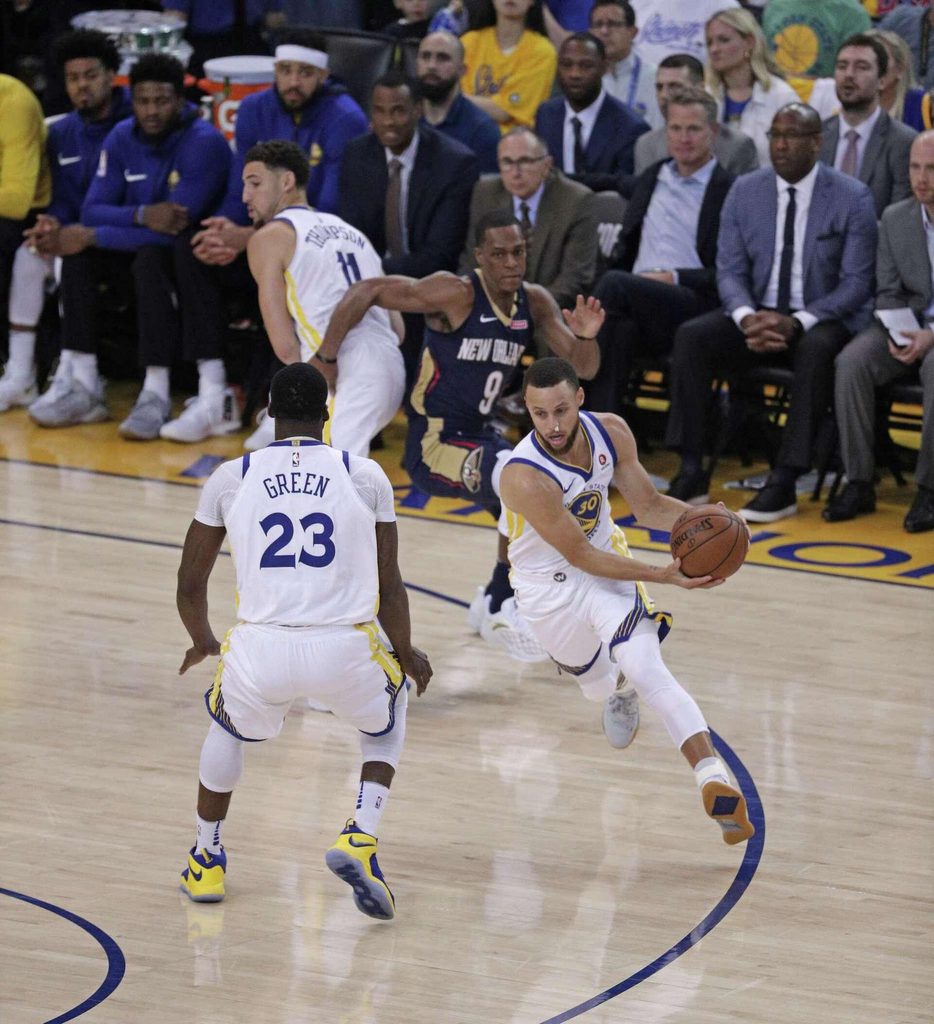
When Steve Kerr became head coach of the Golden State Warriors in 2014, he inherited Stephen Curry, Klay Thompson, Draymond Green and an already successful team.
Then he changed how they moved.
Kerr has openly credited D’Antoni as an influence, along with Gregg Popovich and Phil Jackson. Rather than importing one existing offense, he blended ideas: spacing, screening, cutting, ball movement and player movement.
One of Kerr’s early messages was wonderfully simple:
If you’re not open, pass it.
The ball would eventually find the right player.
Curry became particularly dangerous because he didn’t stop attacking when he gave up the basketball.
He passed.
Moved.
Relocated.
Screened.
Reappeared.
The defense might solve one problem only to discover another had already developed somewhere else.
Golden State’s offense became built around continuous problems.
The fast break had evolved again.
Originally, basketball speed meant something close to:
Get from one basket to the other faster.
Now speed could mean:
Make the defense process information faster.
The ball moves.
Players move.
Spacing changes.
A screen appears.
Someone cuts.
Curry relocates.
Green receives the ball and reads the defense.
A defender helps.
Someone else becomes open.
The possession may technically be happening in the half court.
But the defense is still playing transition basketball mentally.
Golden State won the 2015 championship and ultimately built a dynasty around movement, shooting, defense, intelligence and pace. Kerr’s Warriors became perhaps the clearest modern proof that basketball can remain aggressive and fast even after the traditional fast break has ended.
The History Isn’t Really About Running
Look at the progression.
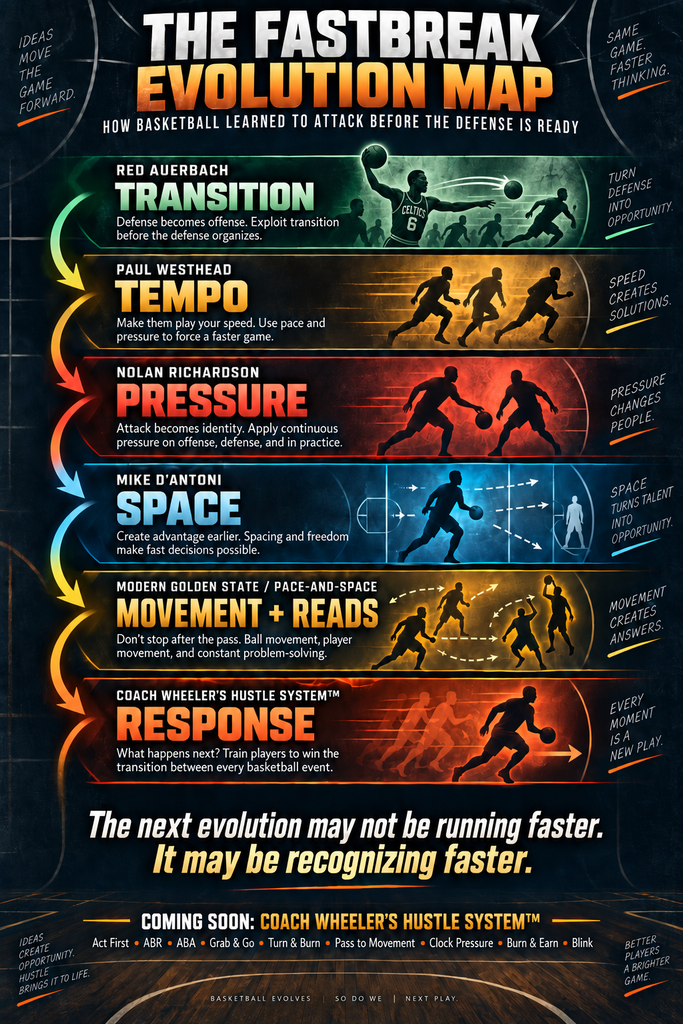
Auerbach: Exploit transition.
Westhead: Control tempo.
Richardson: Apply continuous pressure.
D’Antoni: Create space.
Golden State: Keep players, the ball and defensive decisions moving.
At first glance these appear to be different basketball philosophies. Look closer.
They’re variations on one competitive principle:
Make the opponent solve the next problem before they’re ready to solve it.
That’s why fastbreak basketball keeps returning. It isn’t a fad. It’s a way of exploiting one of basketball’s unavoidable realities. Every event changes the game.
- A rebound changes possession.
- A turnover changes direction.
- A made basket changes responsibilities.
- Penetration changes defensive positioning.
- Help creates an opening.
- A pass changes spacing.
- A shot changes rebounding responsibilities.
- A substitution changes matchups.
- Score and time change strategy.
Every basketball event creates something next. And the team that recognizes that something first has an advantage.
Fastbreak Basketball Has Already Passed the Test
Does playing fast guarantee championships? Obviously not.
Basketball history contains plenty of teams that played quickly and lost. That probably deserves its own discussion.
But the opposite argument—that fastbreak basketball is somehow gimmicky, unsophisticated or incompatible with championship basketball—is extraordinarily difficult to defend.
Red Auerbach used transition basketball while building one of the greatest dynasties in sports.
Nolan Richardson’s attacking style won championships at three different levels, including the NCAA title.
Mike D’Antoni’s Phoenix teams transformed NBA offense and helped push the sport toward the style that followed.
Golden State incorporated pace, spacing and relentless movement into a system that produced championships.
Different eras. Different rules. Different personnel. Different systems.
Same recurring discovery:
An organized team playing quickly can create advantages before an opponent is prepared to defend them.
The important word there is not quickly. It’s organized.
Because there is a difference between playing fast and playing rushed. There is a difference between pressure and gambling. There is a difference between movement and chaos. There is a difference between running harder and recognizing sooner.
And that may be where the next evolution of fastbreak basketball gets interesting.
What Happens Next?
For decades, coaches have been getting better at exploiting particular kinds of speed.
Transition speed.
Tempo.
Pressure.
Spacing.
Ball movement.
Player movement.
But there may be another kind of speed hiding inside the game.
Response speed.
Not simply:
How quickly can we run down the floor?
But:
How quickly do we recognize that something has changed?
A shot went up.
What happens next?
We scored.
What happens next?
The defense helped.
What happens next?
Our press was broken.
What happens next?
We made a mistake.
What happens next?
I’ve become increasingly interested in building basketball around that question.
It has led me toward ideas with names like Act First, Always Be Running, Always Be Attacking, Pass to Movement, Grab & Go, Turn & Burn, Clock Pressure, and something I call Blink.
Together, those ideas are becoming Coach Wheeler’s Hustle System™.
It’s not an attempt to replace what Auerbach, Westhead, Richardson, D’Antoni, Kerr and others discovered.
Quite the opposite.
They’ve already supplied decades of evidence that speed, pressure, transition and intelligent aggression can win basketball games.
The question I’m interested in now is:
What happens if we connect those ideas and train players to win not only the fast break—but the tiny transition between every basketball event and whatever happens next?
Because basketball never stops.
Maybe our players shouldn’t either.