
by Coach Wheeler
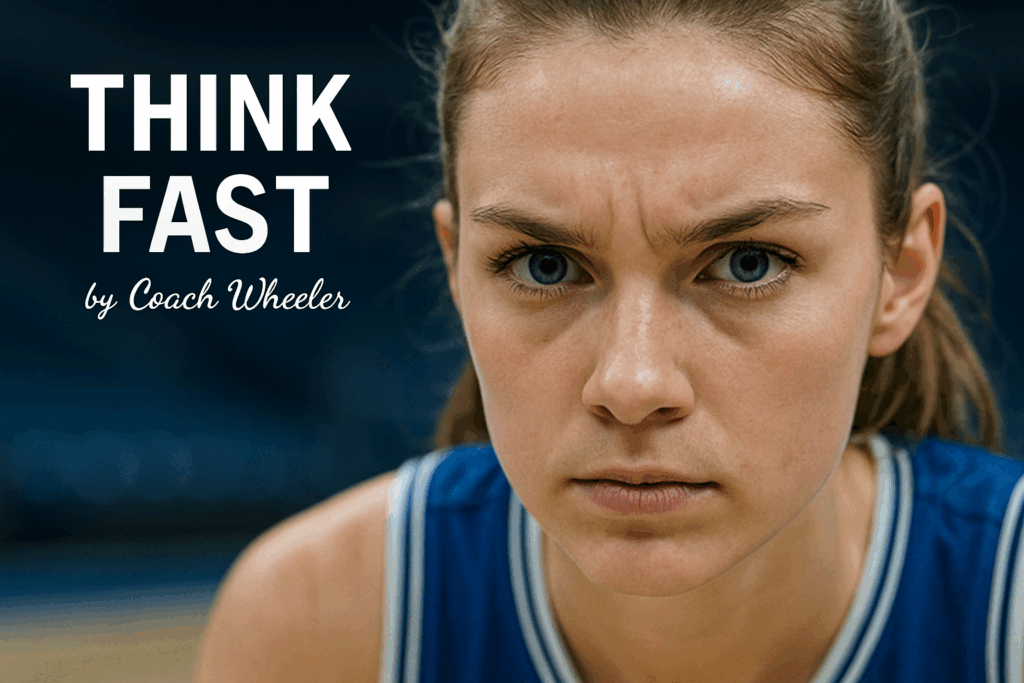
In basketball—and in life—the ability to think fast separates those who react from those who dictate.
Every moment on the court is a decision loop. Someone moves. Someone hesitates. Someone sees what’s coming just a little sooner—and that little bit changes everything.
If you’ve read my earlier article on anticipation, you already know that anticipation is about predicting what’s next. “Think Fast” builds on that. It’s not just about seeing what’s about to happen—it’s about responding faster and better than anyone else when it does.
And the key to doing that lives in a powerful mental model called the OODA Loop—and in your eyes.
The OODA Loop: Your Brain’s Speed System
The OODA Loop—short for Observe, Orient, Decide, Act—was developed by U.S. Air Force Colonel John Boyd to explain how fighter pilots win dogfights. It applies just as well to basketball, business, or life.
- Observe: See what’s happening right now.
- Orient: Make sense of it—connect what you see to what it means.
- Decide: Choose the best response.
- Act: Execute.
Then you loop—again and again. The faster and more accurately you cycle through OODA, the more control you have.
Most people play inside a single OODA loop—they’re reacting to what’s already happened. Winners? They run their loop faster, cleaner, and ahead.
Every trap, every fast break, every defensive read is an OODA race.
The Eyes Have It
Here’s the part most players overlook: your eyes are the front door to your OODA loop.
If your eyes are slow, everything downstream—orientation, decision, action—lags behind.
If your eyes are sharp, your brain starts processing early. You’ve already seen what others haven’t even noticed.
Watch elite defenders—they’re not watching the ball; they’re watching eyes.
Watch great point guards—they don’t just see teammates; they read intentions.
Because here’s the truth few people realize:
At most levels, players’ eyes tell the truth.
They look where they’re about to go, pass, or shoot.
Only the most elite can fake it consistently.
So if you want to think fast, start with seeing better.
Drills to train your eyes:
- Eye tracking: In practice, focus on reading your opponent’s eyes. Can you predict their next move? Test yourself.
- Peripheral awareness: Stand in stance and call out numbers your partner flashes at the edge of your vision. Expand what you see.
- Film study: Pause film at key moments. Where are their eyes? Where should yours be?
The better you train your eyes, the earlier your “Observe” step begins—and the shorter your reaction time becomes.
The Power of Anticipation + OODA
Let’s connect the dots.
Anticipation is projecting forward—“What’s about to happen?”
OODA is your engine for turning that insight into action.
You:
- Observe a tell (the eyes shift, the foot turns).
- Orient based on what that tell means.
- Decide the counter (jump the pass, cut off the lane).
- Act—immediately, confidently, correctly.
Every repetition of that loop gets cleaner, tighter, and faster.
You stop thinking. You just flow.
That’s when your instincts start winning possessions before your body even moves.
Train to Think Fast
1. Cue-response drills:
Have a partner give unpredictable cues—eyes, hands, fakes. You respond instantly.
Time your reactions. Then shave the delay.
2. “What if” scenarios:
Mentally run your OODA loop.
- “What if she looks left but dribbles right?”
- “What if the post flashes high?”
The more you mentally rehearse, the faster your brain connects cues to actions.
3. Chaos drills:
Add crowd noise, pressure, fatigue.
Your goal: stay calm, see clearly, loop faster.
4. Eye-first defense:
During scrimmages, challenge yourself to read the opponent’s eyes three times before the possession ends. See how often you predict correctly. Track it. You’ll be shocked how much the eyes give away.
The Real Secret
Thinking fast isn’t about guessing—it’s about processing.
When you’ve trained your eyes to see, your mind to orient, your will to decide, and your body to act—
—you’re running laps around players still stuck in hesitation.
Your speed comes not from moving faster, but from seeing sooner and choosing better.
That’s why great players look like they’re in slow motion even when the game moves at lightning speed.
They’re already a loop ahead.
The Challenge
This week:
- Watch eyes. Every game, every drill. Count how many true cues you can spot.
- Run your loop. Observe → Orient → Decide → Act—intentionally, every possession.
- Reflect. After practice, ask: Where did I hesitate? Where did I loop fast?
Speed isn’t just a physical thing. It’s a mental advantage.
Think fast. Play ahead. Win early.
Let’s roll.
— Coach Wheeler